
The beginning (about 61 million years ago)
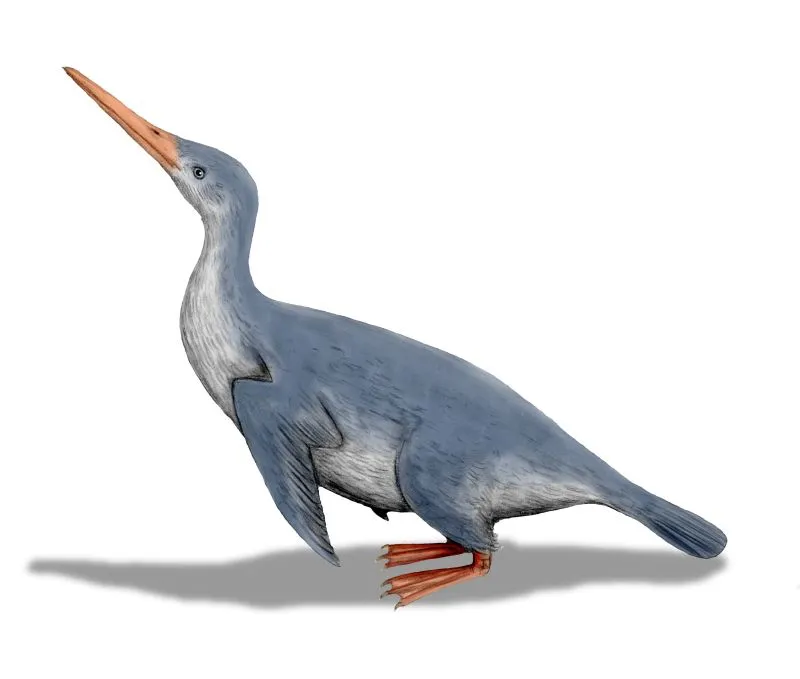
Reconstruction: Nobu Tamura / CC BY 3.0
One of the oldest known penguins is Waimanu (Waimanu manneringi). Its fossils were found in rock layers in New Zealand and are thought to be about 61.6–60.5 million years old. From the structure of its wings, it is thought that it could not fly and used its wings to dive underwater.
The dinosaurs disappeared in the mass extinction about 66 million years ago. This means that only a few million years later, Waimanu was already living in the sea.
Changes over time
Giant penguins (about 59.5–55.5 million years ago)
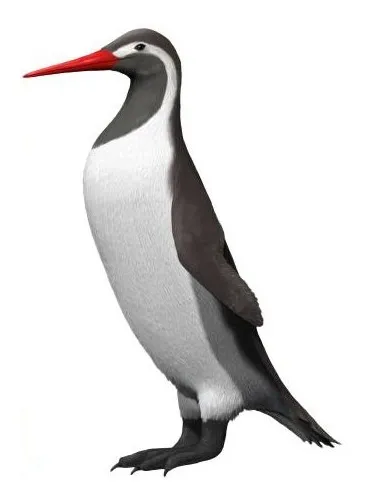
Reconstruction (Kumimanu biceae, another species related to Kumimanu): Nobu Tamura
About 59.5–55.5 million years ago, a giant penguin called Kumimanu (Kumimanu fordycei) lived in New Zealand. Its weight is estimated at about 150 kg, and research gives two values, about 148 kg and about 160 kg. It was more than 3 times the size of the largest penguin alive today and may have been the largest penguin that ever lived.
Meeting Europeans (1497)
In 1497, Vasco da Gama’s fleet stopped at the Bay of São Braz (today’s Mossel Bay) in South Africa on its way to India. A crew member’s journal of the voyage describes birds seen there that were “as big as ducks” and could not fly. These are thought to be the birds now called African penguins, and this is one of the earliest records of penguins in European history.
In 1520, Antonio Pigafetta was sailing with Magellan’s fleet on its voyage around the world. On an island off the coast of Patagonia in South America, he recorded “geese” that were black, did not fly, and ate fish. These birds are now called Magellanic penguins, and the species is named after Magellan, who led the voyage.
The name “penguin” (1844)
In the late 16th century, the English word “penguin” originally meant the great auk, a bird of the North Atlantic. The origin of the word is not clear. A well-known theory says it comes from the Welsh words pen (head) and gwyn (white), but even dictionaries treat it only as a guess.
Later, the name came to be used for the flightless birds of the southern seas, which looked similar. Great auks and penguins look alike but are not closely related.
The great auk was hunted to extinction by people. Birds caught in 1844 on Eldey, an island off Iceland, were the last individuals with a confirmed record. Today the name “penguin” belongs only to the birds of the Southern Hemisphere.
To Japan on whaling ships (1959)
After World War II, Japan resumed whaling in the Southern Ocean in 1946 to make up for a shortage of food. Before long, penguins brought back by whaling ships were being given to zoos and aquariums around the country.
In 1959, four chinstrap penguins came to Nagasaki Aquarium (the predecessor of today’s Nagasaki Penguin Aquarium), carried by a whaling ship.
Breeding in Japan (1965)
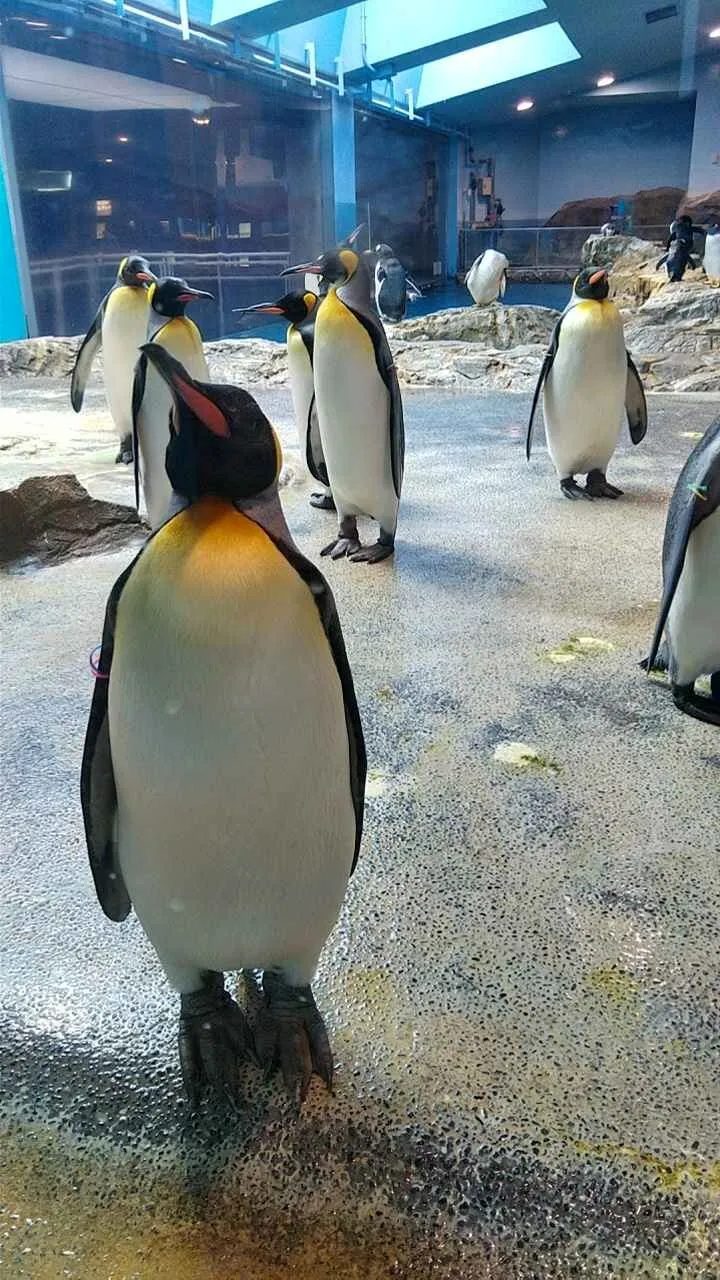
Photo (the successor, Nagasaki Penguin Aquarium, 2013): Hinata2323
In 1965, a king penguin chick hatched at Nagasaki Aquarium. It was the first time king penguins had bred in Japan.
Today (2026)
In a global checklist of the world’s birds, penguins are divided into 19 species in 6 genera (groups of closely related species).
Penguins are threatened by competition with fisheries for food, bycatch (being caught by accident in nets set for other fish), damage to their breeding sites, pollution of the sea, and climate change. In April 2026, the emperor penguin was moved up on the IUCN Red List from Near Threatened (NT) to Endangered (EN), a category with a high risk of extinction, mainly because sea ice is breaking up early and being lost.
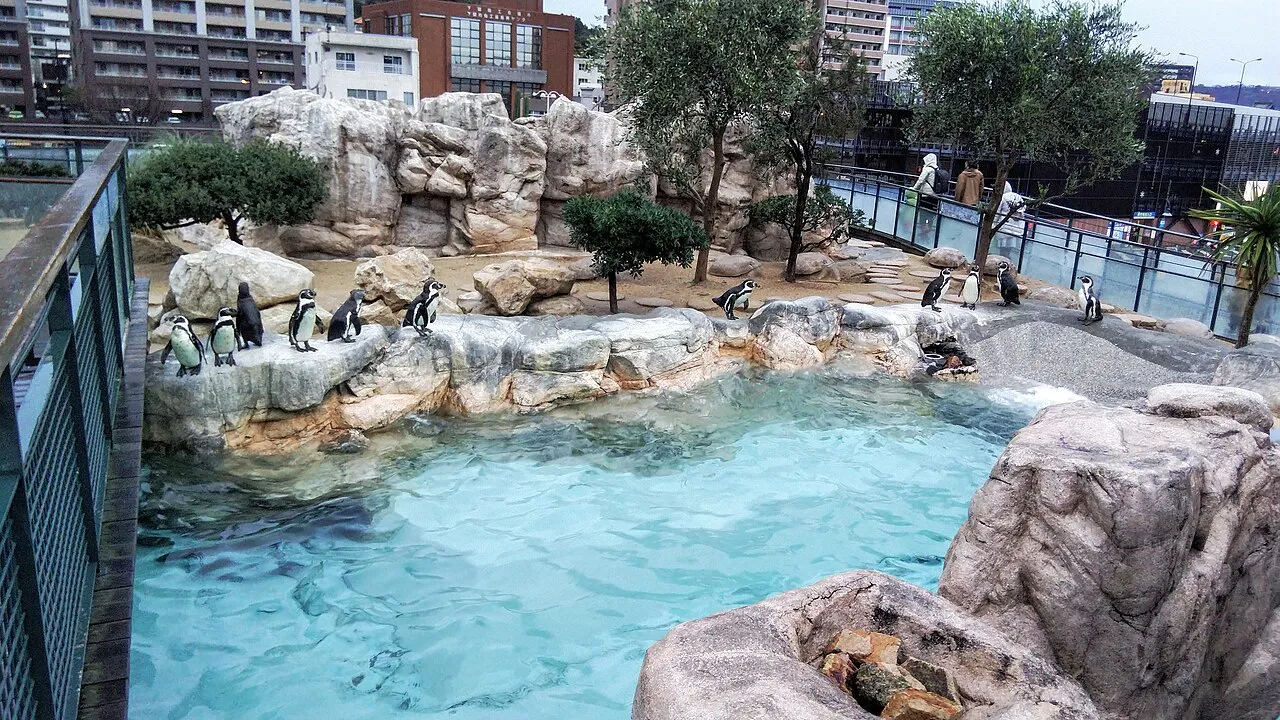
Photo: 要塞騎士
Japan is said to keep more penguins than any other country in the world. An article written in 2017 by the director of Nagasaki Penguin Aquarium says that about 4,000 penguins of 11 species were kept in Japan. A paper published in 2023 says that more than 3,000 penguins of 11 species are kept.
Since the time of Waimanu, penguins have swum underwater with their wings instead of flying. Today’s penguins also move through the water with wings shaped like flippers. What has changed is that people came to know penguins, gave them a name, and became able to see them up close. And now, the way people live is changing the seas where penguins live.
Sources
- Early Penguin Fossils, plus Mitochondrial Genomes, Calibrate Avian Evolution (Molecular Biology and Evolution (Oxford University Press), checked 2026/10/08)
Used for: The beginning (about 61 million years ago); Today (2026) - Mannering’s penguin (New Zealand Birds Online, checked 2026/10/08)
Used for: The beginning (about 61 million years ago) - New evidence comet or asteroid impact was last straw for dinosaurs (University of California, Berkeley, checked 2026/10/08)
Used for: The beginning (about 61 million years ago) - Date of dinosaur extinction fixed more accurately than ever before (University of Glasgow, checked 2026/10/08)
Used for: The beginning (about 61 million years ago) - Largest-known fossil penguin provides insight into the early evolution of sphenisciform body size and flipper anatomy (Journal of Paleontology (Cambridge University Press), checked 2026/10/08)
Used for: Giant penguins (about 59.5–55.5 million years ago) - The largest penguin that ever lived (University of Cambridge, checked 2026/10/08)
Used for: Giant penguins (about 59.5–55.5 million years ago) - Discovery of largest-known penguin species reveals significant evolutionary insight (Massey University, checked 2026/10/08)
Used for: Giant penguins (about 59.5–55.5 million years ago) - A Journal of the First Voyage of Vasco da Gama, 1497–1499 (translated by E. G. Ravenstein, Hakluyt Society, 1898 (Project Gutenberg edition), checked 2026/10/08)
Used for: Meeting Europeans (1497) - Make Way for the African Penguins (Smithsonian Magazine, checked 2026/10/08)
Used for: Meeting Europeans (1497) - The Philippine Islands, 1493-1898, Volume 33, 1519-1522 (Antonio Pigafetta, “Primo viaggio intorno al mondo”, translated by J. A. Robertson, 1906 (Project Gutenberg edition), checked 2026/10/08)
Used for: Meeting Europeans (1497) - Magellanic penguin (Encyclopaedia Britannica, checked 2026/10/08)
Used for: Meeting Europeans (1497) - penguin (n.) (Online Etymology Dictionary, checked 2026/10/08)
Used for: The name “penguin” (1844) - penguin (Merriam-Webster, checked 2026/10/08)
Used for: The name “penguin” (1844) - Great Auk (British Trust for Ornithology, checked 2026/10/08)
Used for: The name “penguin” (1844) - Great Auk (The Canadian Encyclopedia, checked 2026/10/08)
Used for: The name “penguin” (1844) - Great auk (Encyclopaedia Britannica, checked 2026/10/08)
Used for: The name “penguin” (1844) - 学芸員コラム Vol.16(長崎にペンギン?―1―) (長崎市長崎学研究所, checked 2026/10/08)
Used for: To Japan on whaling ships (1959) - ペンギンが主役の水族館 (楠田幸雄, Ocean Newsletter No. 408, 笹川平和財団 海洋政策研究所, checked 2026/10/08)
Used for: To Japan on whaling ships (1959); Breeding in Japan (1965); Today (2026) - 長崎ペンギン水族館について (長崎ペンギン水族館, checked 2026/10/08)
Used for: To Japan on whaling ships (1959) - オオサマペンギンの繁殖について (水江修治・本川富也・白井和夫, 動物園水族館雑誌, 日本動物園水族館協会, checked 2026/10/08)
Used for: Breeding in Japan (1965) - The Checklist v2026 (AviList, checked 2026/11/01)
Used for: Today (2026)
Value in this source: penguins are divided into 19 species in 6 genera - Pollution, habitat loss, fishing, and climate change as critical threats to penguins (Conservation Biology, checked 2026/10/08)
Used for: Today (2026) - Emperor penguin and Antarctic fur seal now Endangered due to climate change (IUCN, checked 2026/10/08)
Used for: Today (2026) - Emperor Penguin now Endangered due to climate change (BirdLife International, checked 2026/10/08)
Used for: Today (2026) - Nationwide Survey about the Occurrence of Aspergillosis in Captive Penguins in Zoos and Aquariums in Japan (Animals (MDPI), checked 2026/10/08)
Used for: Today (2026) - Penguin (Encyclopaedia Britannica, checked 2026/10/08)
Used for: Today (2026)