
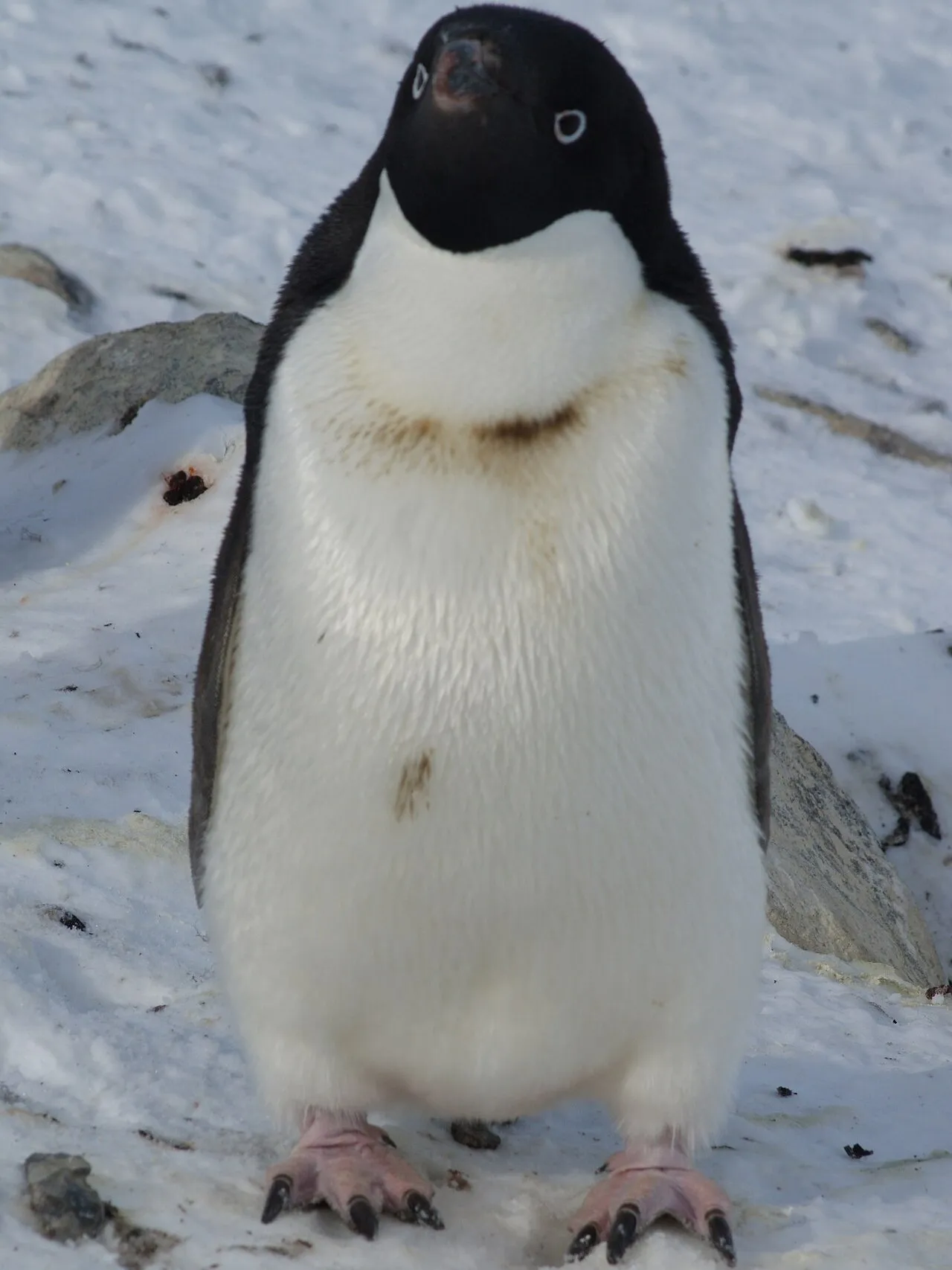
Adelie Penguin
Scientific name Pygoscelis adeliae
Page last checked: 2026/11/01
A medium-sized penguin that breeds around almost the entire coast of Antarctica, recognized by the white ring around its eye.
Key facts
- Length
70–71 cm
- Weight
3–8.1 kg
- Population
3,790,000 pairs (2014 survey)
- Range
It spends most of its life in the seas around Antarctica and stays close to sea ice. After the breeding season it moves to waters where sea ice persists to molt, and it spends the winter among the pack ice. Stray birds occasionally reach New Zealand, Australia, Argentina and elsewhere.
It breeds on rocky ground free of snow and ice around almost the entire coast of Antarctica and on nearby islands. About 34% of the world population breeds in the Ross Sea region, where Cape Adare and Cape Crozier are large colonies. In East Antarctica there are colonies in the Windmill Islands near Casey Station and on Béchervaise Island near Mawson Station. There are also very large colonies in the Danger Islands, east of the tip of the Antarctic Peninsula, and it breeds in the South Orkney Islands, away from the continent.
Created with Grok
Features
A medium-sized penguin with the classic black-and-white penguin look, recognized by the white ring around its eye. Its weight differs between sources, given as 3–6 kg or 3.6–8.1 kg. Males and females are almost the same size and hard to tell apart. It is one of the few penguins that live on the Antarctic continent, and it stays close to ice-covered seas all year round. It walks many kilometers across sea ice to return to its colony, and slides on its belly when there is snow on the ground.
How to identify
- Around the eye: Distinct white ring
- Bill: Mostly feathered, short and stubby
- Head to chin: Black from head to face and chin
- Tail: Longer than in other penguins
Created with Grok
- It has a distinct white ring around the eye and no other markings on the face.
- The head, face and chin, and the back, are black.
- The bill is mostly covered by feathers, so it looks short and stubby.
- The tail is longer than in other penguins.
- White-chinned juveniles resemble the chinstrap penguin, but the border between black and white passes above the eye in the chinstrap penguin and below the eye in the juvenile Adelie penguin.
Chicks and juveniles
- Chick
Until about 1.5–2.5 months old
- Down: Pale gray, later replaced by darker brown
Created with Grok
A newly hatched chick is covered in pale gray down with a darker head, which is later replaced by darker brown down. Around February the down is shed and replaced by juvenile feathers.
- Juvenile
From about 1.5–2.5 months old
- Around the eye: White ring faint or absent
- Chin: White
- Back: Dark blue feathers
Created with Grok
A newly fledged juvenile has dark blue feathers on the back and a white chin, and the white ring around the eye is faint or absent.
Life
It feeds mainly on krill such as Antarctic krill (small shrimp-like animals that live in swarms in the Southern Ocean), and also eats fish, amphipods (small crustaceans related to sandhoppers) and squid. Near the colony it takes more fish, amphipods and ice krill (a species of krill), and offshore more Antarctic krill. It catches prey by pursuit diving and usually feeds in shallow water, but the deepest recorded dives are 175 m and 180 m. After the breeding season it moves to the pack ice; it is said to travel up to 1,000–2,500 km from the colony depending on the distance to the ice edge, and is known to swim more than 1,200 km from the colony.
Breeding
Birds return to the colony in September–October, or in mid to late October, and build nests of small stones on rocky ground free of snow and ice. They sometimes steal stones from other nests, and where possible they pair with the same mate at the same nest every year. Two eggs are laid by mid-November and incubated by both parents in turn. Chicks hatch in December and gather in groups with other chicks when they are 2–3 weeks old. Chicks fledge at 50–56 days, or 7–9 weeks, and go to sea in February or March.
Other penguins
- King Penguin
- Emperor Penguin
- Adelie Penguin
- Chinstrap Penguin
- Gentoo Penguin
- Little Penguin
- African Penguin
- Magellanic Penguin
- Humboldt Penguin
- Galapagos Penguin
- Yellow-eyed Penguin
- Macaroni Penguin
- Royal Penguin
- Erect-crested Penguin
- Fiordland Penguin
- Snares Penguin
- Northern Rockhopper Penguin
- Western Rockhopper Penguin
- Eastern Rockhopper Penguin
Sources
- AviList v2026 (The Global Avian Checklist) (AviList Core Team, checked 2026/11/01)
Used for: Range and breeding sites - 世界のペンギン アデリーペンギン(夏の企画展示 2019「のぞいてみよう!ペンギンワールド」) (国立極地研究所 南極・北極科学館, checked 2026/10/10)
Used for: Length, Weight, Features, Life
Values from this source: Weight is 3.6–8.1 kg / The deepest recorded dive is 180 m - 世界のペンギン アデリーペンギンの一年(夏の企画展示 2019「のぞいてみよう!ペンギンワールド」) (国立極地研究所 南極・北極科学館, checked 2026/10/10)
Used for: Chicks and juveniles, Breeding
Values from this source: Birds return to the colony in mid to late October - Adelie penguin (New Zealand Birds Online, checked 2026/10/25)
Used for: Length, Weight, Range and breeding sites, How to identify, Chicks and juveniles, Features, Life, Breeding
Values from this source: About 34% of the world population breeds in the Ross Sea region / The deepest recorded dive is 175 m / Birds return to the colony in September–October / Chicks fledge at 50–56 days - Adélie penguin (Australian Antarctic Division (Australian Antarctic Program), checked 2026/10/25)
Used for: Length, Weight, Range and breeding sites, How to identify, Chicks and juveniles, Features, Life, Breeding
Values from this source: Weight is 3–6 kg / The deepest recorded dive is 175 m / Swims more than 1,200 km from the colony / Chicks fledge at 7–9 weeks - Adelie Penguin Pygoscelis adeliae (Species factsheet) (BirdLife International, checked 2026/10/26)
Used for: Range and breeding sites, Features, Life, Breeding
Values from this source: Travels up to 1,000–2,500 km from the colony - Pygoscelis adeliae, Adelie penguin (SeaLifeBase, checked 2026/10/10)
Used for: Length - First global census of the Adélie Penguin (Lynch & LaRue, The Auk 131(4): 457–466) (American Ornithologists' Union (2014), checked 2026/10/10)
Used for: Population
Values from this source: About 3.79 million breeding pairs (3.52–4.10 million) / An estimate published in 2014, from surveys made in different years at each colony