
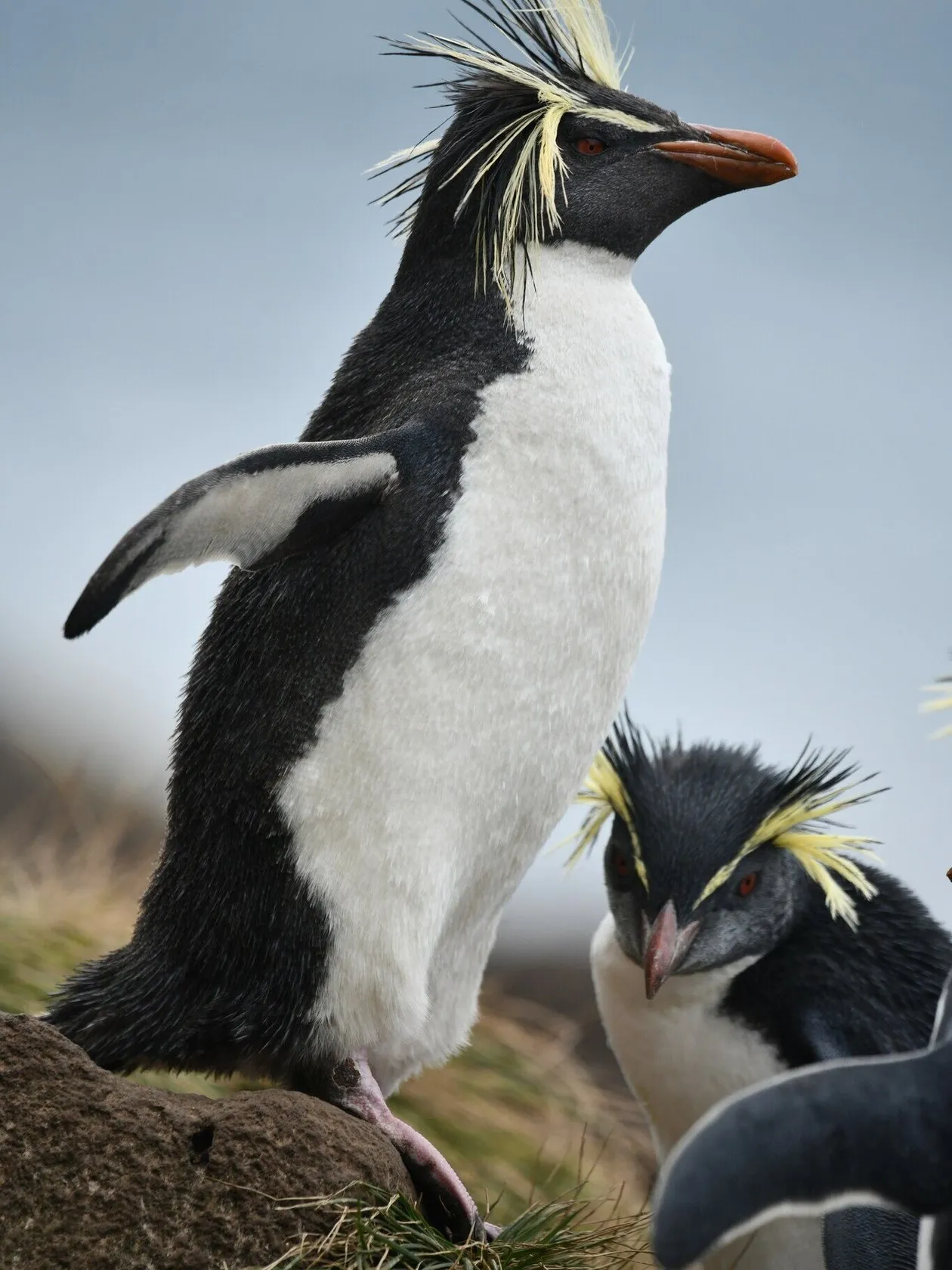
Northern Rockhopper Penguin
Scientific name Eudyptes moseleyi
Page last checked: 2026/11/01
A rockhopper penguin with a long yellow crest that droops from behind the eye. It breeds on only seven islands in the South Atlantic and southern Indian Ocean.
Key facts
- Length
45–58 cm
- Weight
2.4–4.3 kg
- Population
206,850 pairs (2020 survey)
- Range
After the molt it stays at sea through the winter without coming ashore. In tracking studies, birds from Nightingale Island and Gough Island in the Atlantic dispersed widely, from off the continental shelf of southern Africa toward South America and south to around the boundary between the cold Antarctic waters and the warmer waters to the north, while birds from Amsterdam Island in the Indian Ocean moved mainly east to southeast, to waters far from the colony. Stray birds have also been recorded on the coasts of South Africa, the Falkland Islands, Australia and New Zealand.
It breeds on only seven islands in the South Atlantic and southern Indian Ocean, at 37–40°S. In the South Atlantic these are the Tristan da Cunha group (Tristan, Inaccessible, Nightingale and Middle Islands) and Gough Island, and in the southern Indian Ocean Amsterdam Island and St Paul Island. Most breeding birds are on the Atlantic side, given as about 90%, or more than 80%. Nests are on boulder beaches on Gough and Tristan, among tall tussock grass on Nightingale, Middle and Inaccessible, and on Amsterdam and St Paul there are also colonies as high as about 170 m above sea level.
Created with Grok
Features
One of the crested penguins, and its long yellow crest drooping from behind the eye is said to be the finest in the genus. It breeds on only seven islands at 37–40°S, and all of its breeding sites except Gough Island lie north of the boundary between the warm subtropical waters and the cold waters to the south. On land it walks upright and hops along on its strong pink feet. Its weight changes greatly through the season; it is about 3 kg at the start of the breeding season, averages 4.3 kg before the molt, and often falls to about 2.5 kg by the end of the season after losing much weight during the molt, while another source gives 2.4–4.2 kg.
How to identify
- Back of the head: Black, spiky feathers
- Eye: Red
- Bill: Thick, reddish brown
- Crest: Droops from behind the eye, well below the border of black and white on the throat
Created with Grok
- It has a thin golden-yellow line above the eye, and the long yellow crest drooping from behind the eye reaches well below the border between the black and white of the throat, the only crested penguin in which it does so.
- It is slightly larger than the western and eastern rockhopper penguins.
- Its crest is much longer and bushier than those of the western and eastern rockhopper penguins.
- The eyes are red, the bill is thick and reddish brown, and the feet are pink.
- It has black, spiky feathers on the back of the head.
Chicks and juveniles
- Chick
Until about 2–2.5 months old
- Juvenile
From about 2–2.5 months old
- Crest: No long crest like an adult's
Created with Grok
Juveniles lack the long crest of adults.
Life
It eats crustaceans such as krill (crustaceans are relatives of shrimps and crabs), squid and fish. Krill is the main food in the Tristan da Cunha group, and small squid and crustaceans are common at Amsterdam Island; on both, fish becomes more common as the chicks grow. It travels to distant waters to feed while incubating, and feeds near the colony while the chicks are small. After raising its chicks it builds up reserves at sea, returns to land to molt in January–February, and then stays at sea until the next breeding season.
Breeding
Birds return to the colony from late July to August, the males arriving before the females. Two eggs are laid in early September; the second egg is larger, and the first is often lost early. Both parents take turns incubating for about 32–34 days, and after hatching the male guards the chick and the female brings food every day. Chicks then form groups with other chicks while both parents go to find food, and they go to sea in December–January, about 9–10 weeks after hatching.
Other penguins
- King Penguin
- Emperor Penguin
- Adelie Penguin
- Chinstrap Penguin
- Gentoo Penguin
- Little Penguin
- African Penguin
- Magellanic Penguin
- Humboldt Penguin
- Galapagos Penguin
- Yellow-eyed Penguin
- Macaroni Penguin
- Royal Penguin
- Erect-crested Penguin
- Fiordland Penguin
- Snares Penguin
- Northern Rockhopper Penguin
- Western Rockhopper Penguin
- Eastern Rockhopper Penguin
Sources
- AviList v2026 (The Global Avian Checklist) (AviList Core Team, checked 2026/11/01)
Used for: Range and breeding sites - Northern Rockhopper Penguin Eudyptes moseleyi (Species factsheet) (BirdLife International, checked 2026/10/26)
Used for: Range and breeding sites, Population, Features, Life, Breeding
Values from this source: About 90% of breeding birds are on the Atlantic side / All breeding sites except Gough Island lie north of the boundary between the warm subtropical waters and the cold waters to the south / An estimate from the 2020 assessment, combining counts from each island - Northern rockhopper penguin (New Zealand Birds Online, checked 2026/10/26)
Used for: Length, Weight, Range and breeding sites, How to identify, Chicks and juveniles, Features, Life, Breeding
Values from this source: Its crest is much longer and bushier / The long yellow crest drooping from behind the eye is the finest in the genus / Chicks go to sea at 9–10 weeks old / Length is 55 cm - Northern rockhopper penguin (Australian Antarctic Division (Australian Antarctic Program), checked 2026/10/26)
Used for: Weight, Range and breeding sites, Chicks and juveniles, Features, Life, Breeding
Values from this source: Weight is about 3 kg at the start of the breeding season, averages 4.3 kg before the molt, and often falls to about 2.5 kg by the end of the season / Chicks go to sea about 10 weeks after hatching - Northern rockhopper penguin (Two Oceans Aquarium, checked 2026/10/09)
Used for: Weight, Features
Values from this source: Weight is 2.4–4.2 kg - Population trends and conservation status of the Northern Rockhopper Penguin Eudyptes moseleyi at Tristan da Cunha and Gough Island (Cuthbert et al., Bird Conservation International 19(1): 109-120) (Cambridge University Press (2009), checked 2026/10/26)
Used for: Range and breeding sites, Breeding
Values from this source: More than 80% of breeding birds are on the Atlantic side - Revised population estimate and trends for the Endangered Northern Rockhopper Penguin Eudyptes moseleyi at Tristan da Cunha (Robson et al., Bird Conservation International 21(4): 454-459) (Cambridge University Press (2011), checked 2026/10/26)
Used for: Range and breeding sites
Values from this source: An estimate reported in 2011, combining counts from each island - Rockhopper Penguin Eudyptes chrysocome (Marchant & Higgins (eds.), Handbook of Australian, New Zealand and Antarctic Birds, Vol. 1, excerpt) (Oxford University Press (1990), checked 2026/10/26)
Used for: Length
Values from this source: Length is 45–58 cm for the rockhopper penguin in the broad sense, combining the western, eastern and northern subspecies