
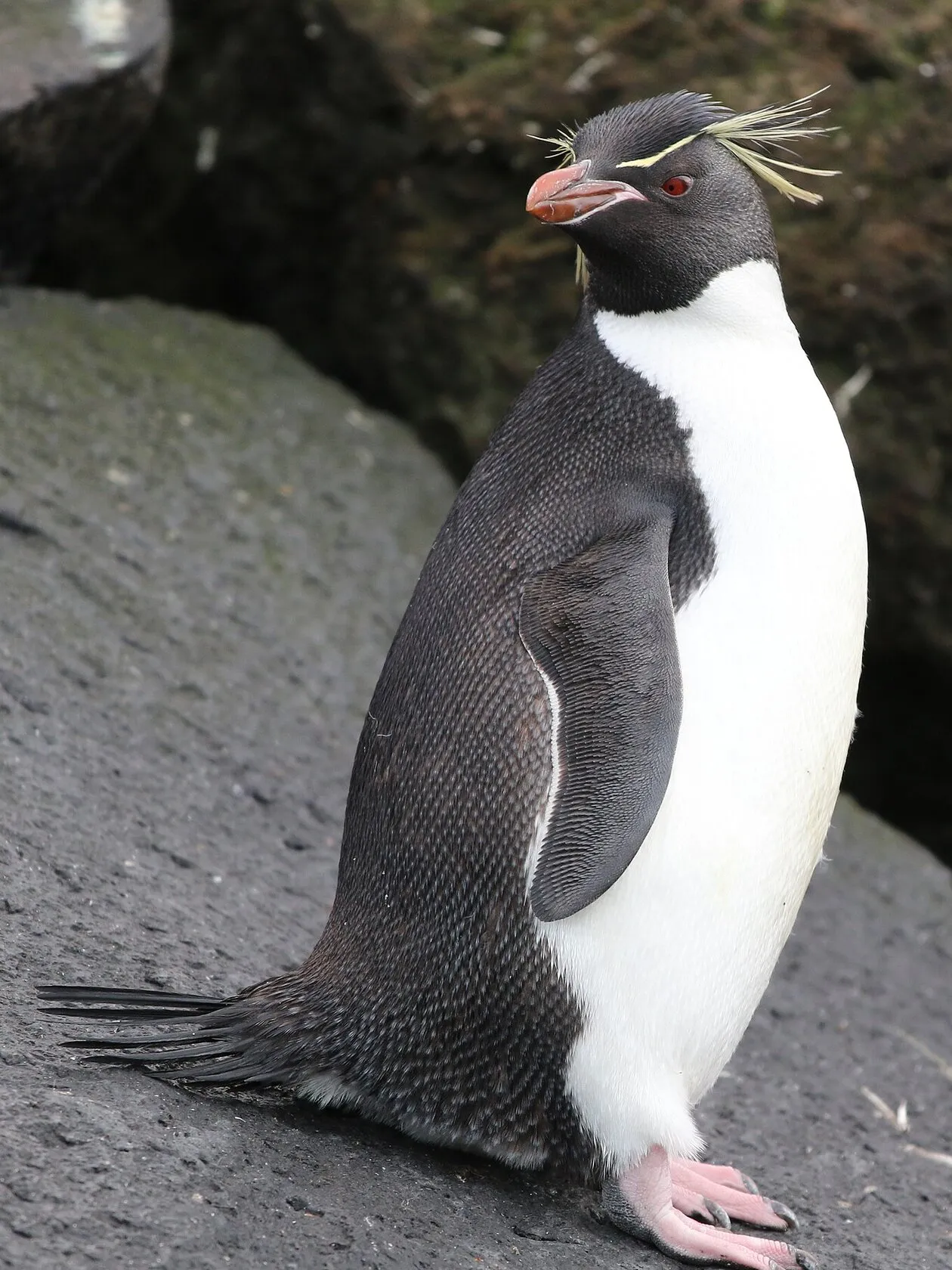
Eastern Rockhopper Penguin
Scientific name Eudyptes filholi
Page last checked: 2026/11/01
A small penguin with red eyes and a yellow crest. It raises its chicks on rocky ground on subantarctic islands in the southern Indian Ocean and south of New Zealand.
Key facts
- Length
45–58 cm
- Weight
2–4 kg
- Population
422,000 pairs (2020 survey)
- Range
It comes ashore only to breed and to molt, and spends the winter at sea. Some birds travel to waters thousands of kilometers from their colonies. It rarely appears on the New Zealand mainland.
It breeds on subantarctic islands in the southern Indian Ocean and south of New Zealand. Its breeding sites are the Prince Edward Islands (Marion Island and Prince Edward Island), the Crozet Islands, the Kerguelen Islands and Heard Island in the Indian Ocean, Macquarie Island (Australia), and the Auckland Islands, Campbell Island and the Antipodes Islands (New Zealand). It nests in colonies on steep slopes near the sea and on rocky ground below cliffs.
Created with Grok
Features
One source calls it the smallest of the crested penguins, while another says it is the largest of the three subspecies of rockhopper penguin. Its red eyes and the yellow crest spreading back from above the eyes are conspicuous. It lays two eggs at a time, but the first egg is smaller than the second, and usually only the one chick from the second egg is raised. Numbers fell sharply during the 20th century at many colonies, including Campbell Island, once its largest breeding site.
How to identify
- Eyebrow stripe: Starts away from the bill, becomes a crest behind the eye
- Base of the bill: Bare skin is pinkish white
- Eye: Red
Created with Grok
- The bare skin at the base of the bill is black in the western rockhopper penguin (E. chrysocome) but pinkish white in this species.
- The yellow eyebrow stripe starts away from the bill, stays thin as far as behind the eye, and spreads into a crest behind the eye.
- In the western rockhopper penguin the eyebrow stripe widens into a wedge shape.
- The drooping crest barely reaches the border between the black and white of the throat, unlike the long crest of the northern rockhopper penguin, which hangs well below it.
- The Snares penguin is larger than this species, with a thicker bill, a broad eyebrow stripe that starts near the bill, and no crest feathers on the back of the head.
- The eyes are red.
Chicks and juveniles
- Chick
- Bill: Black around fledging
- Down: Brown
- Belly: Whitish
Created with Grok
The chick's down is brown, with a whitish belly. Around fledging, the parts that will later turn black are bluish black, the bill is black, and the crest is not yet conspicuous.
- Juvenile
- Crest: Short
- Bill: Smaller and browner than an adult's
- Throat: Mottled gray
Created with Grok
In juveniles the black parts can look dark brown, and the throat is mottled gray. The bill is smaller than an adult's and more brown than orange, and the yellow crest is short.
Life
Food studied on Campbell Island during chick rearing consisted of small fish, squid and octopus, and crustaceans such as krill, and the share of crustaceans is thought to be higher at some colonies. It is thought to feed mainly offshore from its colonies, but this has not been studied in detail. After breeding it goes to sea for the winter; adults tracked from Campbell Island headed east and southeast and traveled to waters thousands of kilometers from the colony.
Breeding
Birds return to the colony in October, the males first and the females a little later. The nest is a hollow lined with gathered pebbles, often in a rock crevice or under a rock, and two eggs are laid in November. Both parents take turns incubating, and after hatching the male guards the chick for a while and the female brings food. Chicks then wait together in groups while both parents bring food, and they fledge around February.
Other penguins
- King Penguin
- Emperor Penguin
- Adelie Penguin
- Chinstrap Penguin
- Gentoo Penguin
- Little Penguin
- African Penguin
- Magellanic Penguin
- Humboldt Penguin
- Galapagos Penguin
- Yellow-eyed Penguin
- Macaroni Penguin
- Royal Penguin
- Erect-crested Penguin
- Fiordland Penguin
- Snares Penguin
- Northern Rockhopper Penguin
- Western Rockhopper Penguin
- Eastern Rockhopper Penguin
Sources
- AviList v2026 (The Global Avian Checklist) (AviList Core Team, checked 2026/11/01)
Used for: Range and breeding sites - イワトビペンギン(ペンギンライブラリー) (ホシザキ株式会社, checked 2026/10/26)
Used for: How to identify, Features
Values from this source: The largest of the three subspecies of rockhopper penguin / Hops over rocks with both feet together / Treats it as one of three subspecies of rockhopper penguin, named southern (ミナミ, the western rockhopper penguin on this site), northern (キタ) and eastern (ヒガシ) in Japanese - Eastern rockhopper penguin (Kyle W. Morrison) (New Zealand Birds Online, checked 2026/10/26)
Used for: Length, Weight, Range and breeding sites, How to identify, Chicks and juveniles, Features, Life, Breeding
Values from this source: The smallest of the crested penguins / Length is 45–55 cm - Southern rockhopper penguin (Australian Antarctic Division (Australian Antarctic Program), checked 2026/10/09)
Used for: Weight, Features, Breeding - Southern Rockhopper Penguin Eudyptes chrysocome (Species factsheet) (BirdLife International, checked 2026/10/26)
Used for: Range and breeding sites, Population, Features, Life, Breeding
Values from this source: An estimate from the 2020 assessment, combining surveys of each island from 1982 to 2018/19 - Rockhopper Penguin Eudyptes chrysocome (Marchant & Higgins (eds.), Handbook of Australian, New Zealand and Antarctic Birds, Vol. 1, excerpt) (Oxford University Press (1990), checked 2026/10/26)
Used for: Length
Values from this source: Length is 45–58 cm for the rockhopper penguin in the broad sense, combining the western, eastern and northern subspecies