
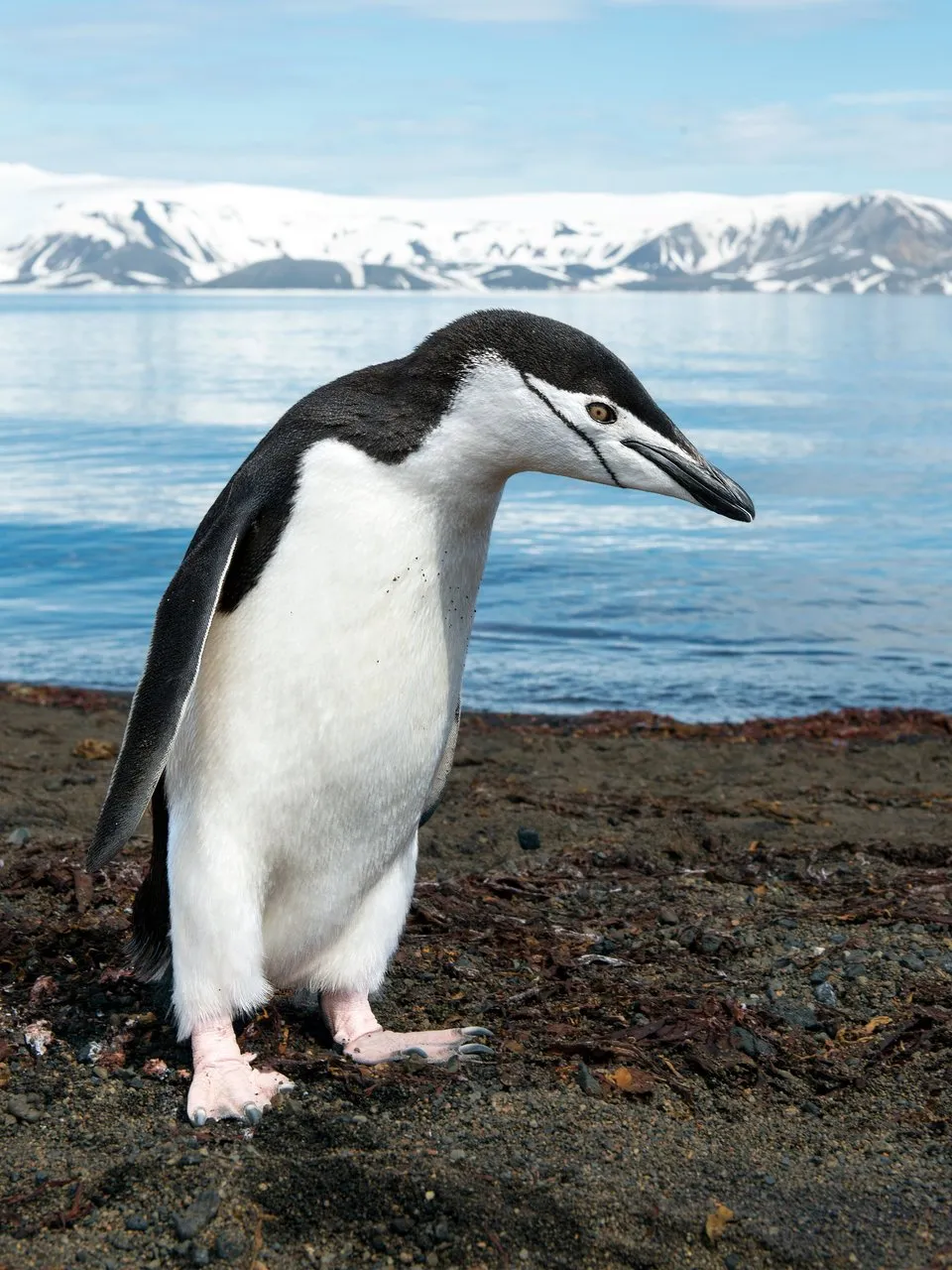
Chinstrap Penguin
Scientific name Pygoscelis antarcticus
Page last checked: 2026/11/01
A penguin with a thin black line under its chin. It forms large colonies on the coasts of the Antarctic Peninsula and the islands of the South Atlantic, feeds on krill and raises two chicks.
Key facts
- Length
71–76 cm
- Weight
3.5–5.5 kg
- Population
3,420,000 pairs (2020 survey)
- Range
In winter it leaves its colonies and lives in the open ocean north of the pack-ice edge. It is said to swim up to 4,500 km from the colony to winter around 60°S, and winter movements of up to 3,200 km from the colony have also been recorded. Most birds stay south of the boundary between the cold Antarctic waters and the warmer waters to the north, but some reach the southern tip of South America and the subantarctic islands. One source says there are no records from New Zealand, while another lists five records between 1978 and 2002.
It breeds in large colonies on ice-free rocky coasts of the Antarctic Peninsula and the surrounding islands of the South Atlantic. About 40% (39.4%) of breeding pairs, or most of the world population (1.5 million pairs), are said to be in the South Sandwich Islands. There are other large colonies in the South Orkney Islands, the South Shetland Islands and on the Antarctic Peninsula, small colonies on South Georgia, Bouvet Island and the Balleny Islands south of New Zealand, and it is also said to breed on Peter I Island. For Heard Island, one source says there are colonies, another treats it as a place where stray birds are recorded, and another says it may breed and occasionally attempts to, but that there is no record of successful breeding.
Created with Grok
Features
A medium-sized penguin recognized by the thin black line that runs from ear to ear under its chin. It belongs to the same genus as the Adelie penguin and the gentoo penguin. Its length differs between sources, given as 71–76 cm, up to 68 cm, about 70 cm, or 75 cm. In other penguins the stronger chick is fed first, but the chinstrap penguin usually raises both of its two chicks. It is said to be the most aggressive of all penguins.
How to identify
- Bill: Black
- Face: White extends above the eye
- Under the chin: Thin black line from ear to ear
- Tail: Black and rather long
Created with Grok
- It has a thin black line running from ear to ear under the chin of its white face.
- The white of the face extends above the eye, so the face looks whiter than that of the juvenile Adelie penguin, in which the border between black and white passes below the eye.
- The bill is black, the feet are pink to orange, and the soles are black.
- The tail is black and rather long.
- It is about the same size as the Adelie penguin.
- The juvenile royal penguin also has a grayish face, but it can be told from the juvenile chinstrap penguin by having at least a few yellow feathers on the forehead.
Chicks and juveniles
- Chick
Until about 1.5–2 months old
- Head and back: Pale gray
- Belly: Whitish
Created with Grok
A newly hatched chick is covered in silvery to pale gray down, and after 2–3 weeks darker gray down grows in. Downy chicks have a pale gray head and back and a whitish belly.
- Juvenile
From about 1.5–2 months old
- Around the eye: Black speckles
- Face: Dull gray above the chin line
Created with Grok
In juveniles the face above the black chin line is dull gray, with black speckles on the face, mainly around the eyes.
Life
Its diet is almost entirely Antarctic krill, along with fish and other crustaceans (relatives of shrimps and crabs). It chases prey in the sea near the colony, swimming as if flying underwater with its flippers. It feeds by day and by night, but dives most often around midnight and noon, and dives deeper during the day. It usually feeds at depths of less than 40 m, or 45 m, and its deepest dives reach 70 m. At sea its main predator is the leopard seal.
Breeding
Birds return to the colony in October or November and lay two eggs in late November in a shallow hollow lined with small stones. Both parents take turns incubating, and the time to hatching is given as 33–36 days, or about 37 days. After being guarded at the nest by a parent for a while, chicks join groups of other chicks at about 3 weeks, or 3–4 weeks. They fledge and go to sea at about 7–8 weeks, and the earliest breed for the first time at 3 years old.
Other penguins
- King Penguin
- Emperor Penguin
- Adelie Penguin
- Chinstrap Penguin
- Gentoo Penguin
- Little Penguin
- African Penguin
- Magellanic Penguin
- Humboldt Penguin
- Galapagos Penguin
- Yellow-eyed Penguin
- Macaroni Penguin
- Royal Penguin
- Erect-crested Penguin
- Fiordland Penguin
- Snares Penguin
- Northern Rockhopper Penguin
- Western Rockhopper Penguin
- Eastern Rockhopper Penguin
Sources
- AviList v2026 (The Global Avian Checklist) (AviList Core Team, checked 2026/11/01)
Used for: Range and breeding sites - Chinstrap Penguin Pygoscelis antarcticus (Species factsheet) (BirdLife International, checked 2026/10/26)
Used for: Range and breeding sites, Life
Values from this source: Most of the world population (1.5 million pairs) breeds in the South Sandwich Islands / Heard Island is a place where stray birds are recorded / Usually feeds at depths of less than 45 m, with the deepest dives reaching 70 m - Chinstrap penguin (Australian Antarctic Division (Australian Antarctic Program), checked 2026/10/26)
Used for: Weight, Range and breeding sites, How to identify, Chicks and juveniles, Features, Life, Breeding
Values from this source: There are also colonies on Heard Island / Usually feeds at depths of less than 40 m / Eggs hatch after 33–36 days / Chicks fledge at about 7–8 weeks - Chinstrap penguin (New Zealand Birds Online, checked 2026/10/26)
Used for: Length, Weight, Range and breeding sites, How to identify, Chicks and juveniles, Features, Life, Breeding
Values from this source: Five records from New Zealand between 1978 and 2002 / Also breeds on Peter I Island / Length is 75 cm / The most aggressive of all penguins / Usually feeds at depths of less than 45 m, with the deepest dives reaching 70 m / Eggs hatch after about 37 days / Chicks join groups at about 3 weeks / Downy chicks have a pale gray head and back and a whitish belly / Chicks shed their down and go to sea at about 50–60 days - Handbook of Australian, New Zealand & Antarctic Birds (HANZAB)Volume 1, Part A, Chinstrap Penguin (Marchant, S. & Higgins, P.J. (eds.)), excerpt (Oxford University Press (1990), on New Zealand Birds Online, checked 2026/10/26)
Used for: Length, Range and breeding sites, How to identify, Chicks and juveniles, Features, Breeding
Values from this source: Winter movements of up to 3,200 km from the colony have been recorded / No records from New Zealand / Also breeds on Peter I Island / May breed on Heard Island and occasionally attempts to, but there is no record of successful breeding / Length is 71–76 cm / Chicks join groups at 3–4 weeks - Pygoscelis antarcticus, Chinstrap penguin (SeaLifeBase, checked 2026/10/10)
Used for: Features
Values from this source: Length is up to 68 cm - A global population assessment of the Chinstrap penguin (Pygoscelis antarctica) (Strycker et al., Scientific Reports 10: 19474) (Nature Publishing Group (2020), checked 2026/10/10)
Used for: Range and breeding sites, Population
Values from this source: Swims up to 4,500 km from the colony to winter around 60°S / About 40% (39.4%) of breeding pairs are in the South Sandwich Islands / About 3.42 million breeding pairs (2.98–4.00 million) / An estimate published in 2020, combining surveys from each site - ペンギン図鑑(ヒゲペンギン) (長崎ペンギン水族館, checked 2026/10/10)
Used for: How to identify, Features
Values from this source: Length is about 70 cm