
Macaroni Penguin
Scientific name Eudyptes chrysolophus
Page last checked: 2026/11/03
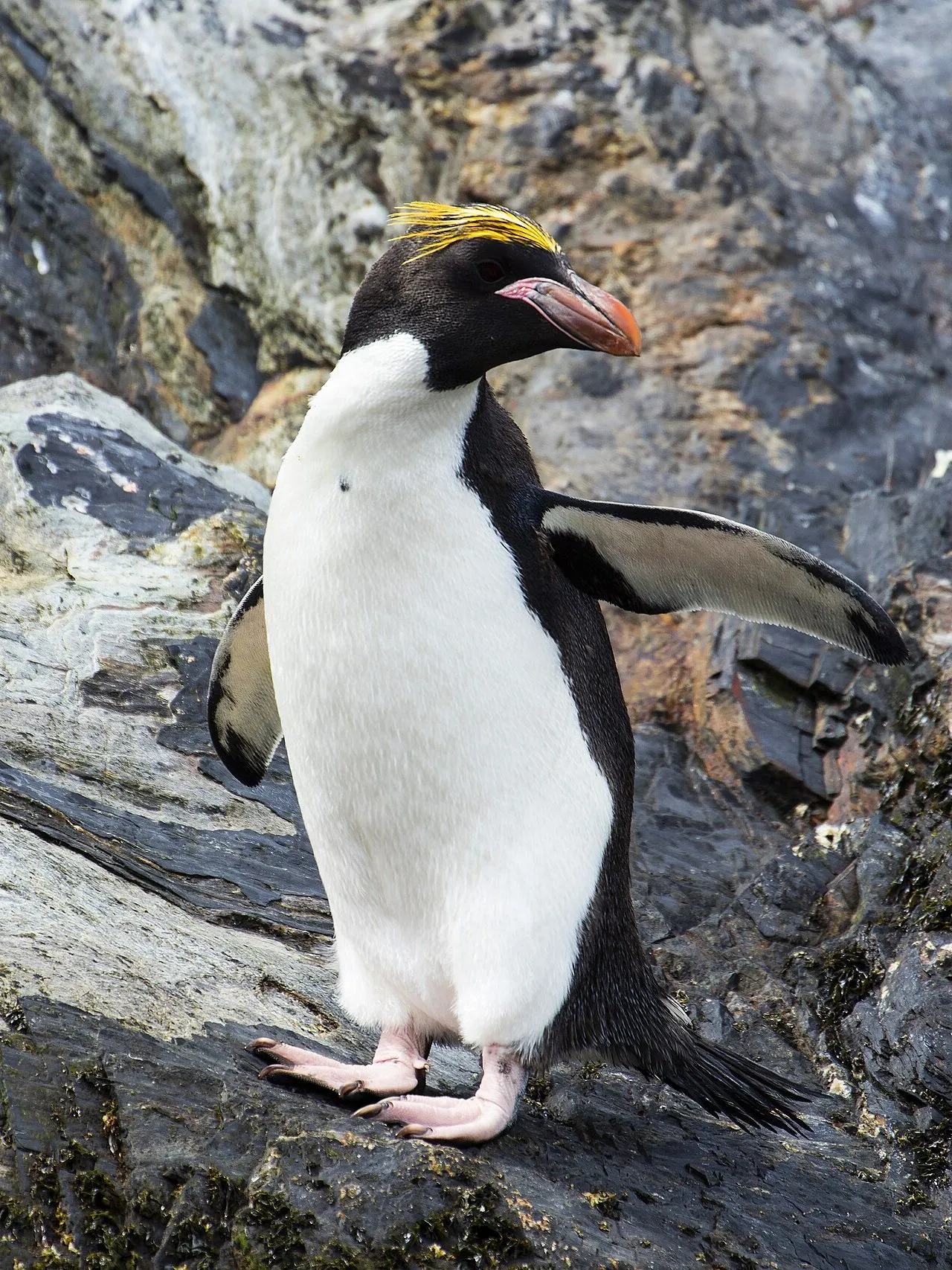
A penguin recognized by its golden crest, which joins in the middle of the forehead. It raises its chicks in large colonies on the slopes of subantarctic islands in the South Atlantic and southern Indian Ocean.
Key facts
- Length
66–74 cm
- Weight
3.1–7 kg
- Population
6,300,000 pairs (2013 survey)
- Range
Outside the breeding season the macaroni penguin leaves its colonies and lives at sea. Birds from the Kerguelen Islands spend the winter in a narrow band of ocean at 47–49°S in the central Indian Ocean, and birds from South Georgia disperse widely across the Scotia Sea.
It breeds on subantarctic islands in the South Atlantic and southern Indian Ocean, near the boundary between the cold Antarctic waters and the warmer waters to the north. The main breeding sites are the Crozet Islands, the Kerguelen Islands, Heard Island, South Georgia and Marion Island; there are also colonies in the South Sandwich Islands, the South Orkney Islands, the South Shetland Islands, Bouvet Island, the Falkland Islands and southern Chile, and a very small number breed on the Antarctic Peninsula.
Created with Grok
Features
Its golden crest is its most striking feature, and it is one of the larger crested penguins. Its size differs between sources, with length given as roughly 51–74 cm and weight as roughly 3.1–7 kg. Like the other crested penguins it lays two eggs of different sizes, but the small first egg rarely produces a chick, and usually only one chick is raised. It breeds in very large colonies, and hybrids with the western rockhopper penguin are known from the Falkland Islands.
How to identify
- Crest: Golden to orange, joins on the forehead
- Eye: Red
- Bill: Thick and orange, pink skin at the gape
- Face: Blackish down to the cheeks
Created with Grok
- The golden to orange crest joins in the middle of the forehead.
- Only this species and the royal penguin have a crest that joins on the forehead; in the other crested penguins the crest is separate on each side.
- The face is blackish down to the cheeks, which tells it from the royal penguin with its white to pale gray face, although some colonies have birds with whitish faces.
- The bill is thick and orange, with conspicuous pink skin at the gape.
- The eyes are red and the feet are pink.
- The erect-crested penguin also has a black face and a long orange bill, but its crest is separate on each side and does not join on the forehead.
Chicks and juveniles
- Chick
Until about 2–2.5 months old
Chicks are covered in brown down.
- Juvenile
From about 2–2.5 months old
- Head: No crest
- Throat: Grayish
- Body: Duller than an adult
Created with Grok
Juveniles are duller than adults, have no crest, and have a grayish throat.
Life
It feeds mainly on small crustaceans such as krill, and at South Georgia it eats large amounts of Antarctic krill. At the Crozet and Kerguelen Islands it also eats amphipods (small crustaceans related to sandhoppers) and lanternfish, so its diet is more varied. It usually dives to less than 50 m. It leaves its colonies and lives at sea during the winter, a period given as May–September at South Georgia and April–September in the Falkland Islands.
Breeding
Birds return to the colony in October and nest in groups on ground ranging from flat areas with almost no grass to steep slopes. Within a colony the eggs are laid at almost the same time; two are laid in each nest, but usually only the larger second egg hatches. Both parents take turns incubating, and the time to hatching is given as 35 days in a study at South Georgia, or 33–40 days. Chicks fledge at about 60–70 days.
Other penguins
- King Penguin
- Emperor Penguin
- Adelie Penguin
- Chinstrap Penguin
- Gentoo Penguin
- Little Penguin
- African Penguin
- Magellanic Penguin
- Humboldt Penguin
- Galapagos Penguin
- Yellow-eyed Penguin
- Macaroni Penguin
- Royal Penguin
- Erect-crested Penguin
- Fiordland Penguin
- Snares Penguin
- Northern Rockhopper Penguin
- Western Rockhopper Penguin
- Eastern Rockhopper Penguin
Sources
- AviList v2026 (The Global Avian Checklist) (AviList Core Team, checked 2026/11/01)
Used for: Range and breeding sites - Macaroni Penguin Eudyptes chrysolophus (Species factsheet) (BirdLife International, checked 2026/10/26)
Used for: Range and breeding sites, Population, Life, Breeding
Values from this source: About 6.3 million breeding pairs, an estimate reported by Crossin et al. in 2013, combining surveys from each site / The earlier estimate was about 9 million pairs - Macaroni penguin (Australian Antarctic Division (Australian Antarctic Program), checked 2026/10/25)
Used for: Weight, Range and breeding sites, Population, Chicks and juveniles, Features, Life, Breeding
Values from this source: Stands about 70 cm tall / Weight is 4–7 kg / Chicks fledge at 60–70 days - Royal penguin (New Zealand Birds Online, checked 2026/10/26)
Used for: Range and breeding sites, How to identify, Features, Breeding
Values from this source: Named by sailors in the 19th century / Just under 9 million breeding pairs of macaroni penguins - Macaroni (Falklands Conservation, checked 2026/10/09)
Used for: Length, Weight, Range and breeding sites, How to identify, Features, Life
Values from this source: Length is 66–74 cm / Weight is 3.5–5.5 kg / Away from the colonies in winter from April to September in the Falkland Islands - Eudyptes chrysolophus, Macaroni penguin (SeaLifeBase, checked 2026/10/09)
Used for: Length - Annual variation in breeding biology of macaroni penguins, Eudyptes chrysolophus, at Bird Island, South Georgia (Williams & Croxall, Journal of Zoology 223(2): 189–202) (Zoological Society of London (1991), checked 2026/10/09)
Used for: Life, Breeding
Values from this source: Away from the colonies in winter from May to September at South Georgia / Eggs hatch after 35 days at South Georgia - Macaroni Penguin Facts and Information (SeaWorld Parks & Entertainment, checked 2026/10/09)
Used for: How to identify, Features, Breeding
Values from this source: Size is 51–61 cm / Named by early English explorers / Eggs hatch after 33–40 days - Macaroni penguin (Research Starters) (EBSCO Information Services, checked 2026/11/03)
Used for: Chicks and juveniles - It has a spiky blond hair cut and is as tall as a bar stool - but what species is this cutie? (Discover Wildlife) (Our Media Ltd (BBC Wildlife Magazine), checked 2026/10/09)
Used for: Weight, Chicks and juveniles, Features
Values from this source: Weight is 3.1–6.6 kg - Eudyptes chrysolophus (macaroni penguin) (Animal Diversity Web (University of Michigan Museum of Zoology), checked 2026/10/25)
Used for: Chicks and juveniles
Values from this source: Chicks go to sea at 60–70 days old - Royal Penguin Eudyptes schlegeli (Marchant & Higgins (eds.), Handbook of Australian, New Zealand and Antarctic Birds, Vol. 1, excerpt) (Oxford University Press (1990), checked 2026/10/26)
Used for: How to identify