
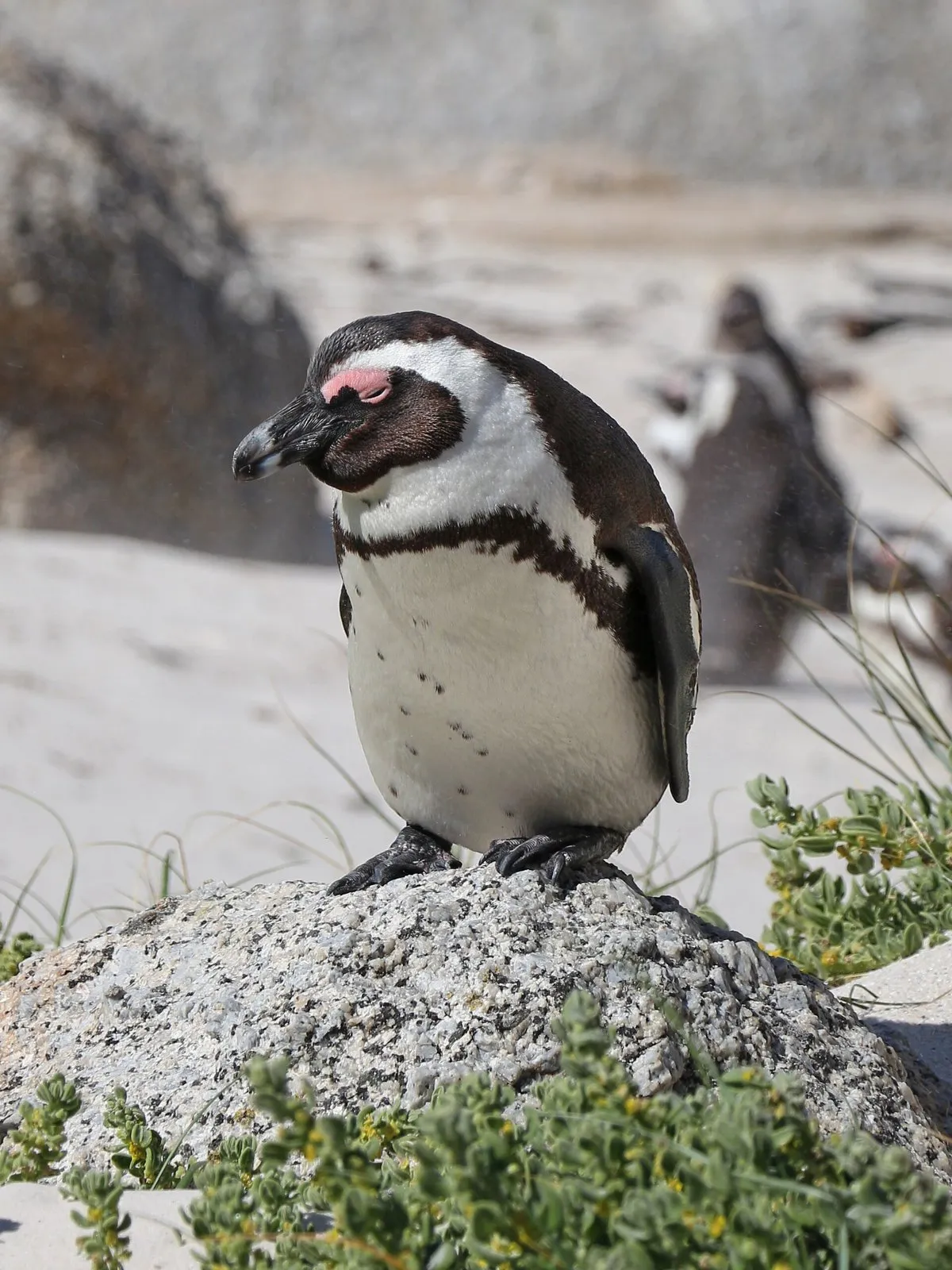
African Penguin
Scientific name Spheniscus demersus
Page last checked: 2026/11/01
The only penguin that breeds on the African continent, raising its chicks on islands off the coasts of South Africa and Namibia. The number of breeding pairs fell from about 17,700 in 2019 to about 9,900 in 2023.
Key facts
- Length
60–70 cm
- Weight
2.1–4 kg
- Population
9,900 pairs (2023 survey)
- Range
It lives in the coastal waters of southern Africa all year round and usually stays close to shore. Outside the breeding season it is found mainly in the waters of the Benguela Current, and stray birds have been recorded as far north as Gabon and Mozambique. Independent juveniles disperse far from the colony where they hatched.
It breeds on islands off the coasts of Namibia and South Africa and at a few places on the mainland coast. The number of colonies differs between sources, given as 26, or as 17 in South Africa and 11 in Namibia. Most of the world population is concentrated at nine sites, namely Dassen Island, Bird Island in Algoa Bay, Stony Point, Robben Island, Dyer Island, Simon's Town and St Croix Island in South Africa, and Halifax Island and Possession Island in Namibia.
Created with Grok
Features
The only penguin that breeds on the African continent, living on temperate coasts with no snow or ice. Because of its deep, donkey-like call it is also known as the jackass penguin (a jackass is a male donkey). It once nested in burrows dug into guano, the built-up layers of seabird droppings, but the guano was stripped away for fertilizer, and it now more often raises its chicks on open ground or in artificial nests.
How to identify
- Above the eye: Whitish bare skin
- Breast band: One black band across the upper breast
- Breast and belly: Black markings
Created with Grok
- A single black band crosses the upper breast from flank to flank.
- There are black markings on the white feathers of the breast and belly.
- There is a patch of whitish bare skin above the eye.
Chicks and juveniles
- Chick
Until about 2–3 months old
- Back: Dark grayish brown in the second down
- Face, throat and belly: White in the second down
Created with Grok
A newly hatched chick is covered in brown down; in its second coat of down the back is dark grayish brown and the face, throat and belly are white.
- Juvenile
From about 2–3 months old
- Head to back: Gray feathers
- Face and breast: No black-and-white pattern
Created with Grok
Juveniles are covered in gray feathers from the head to the back and lack the black-and-white pattern on the face and breast. The back later turns brownish, and it takes about 3 years to gain adult plumage.
Life
It feeds mainly on small schooling fish, and sardine, anchovy and round herring are important prey. In Namibia, where sardines and their relatives have almost disappeared, gobies are now its main food. It usually goes to sea to feed in the morning and returns to the colony in the evening. During the molt it stays ashore without eating, so it feeds heavily and puts on weight beforehand.
Breeding
It breeds all year round, although the peak laying season differs by region, and nests are made in burrows dug in sand or guano, in the shelter of rocks and bushes, and in artificial nest boxes. Both parents take turns incubating the eggs for about 40 days (38–41 days), and after hatching both bring food to the chicks. Chicks fledge at 70–90 days, or 70–80 days. The age of first breeding is given as 4–6 years, or usually 4 years (2–7 years).
Other penguins
- King Penguin
- Emperor Penguin
- Adelie Penguin
- Chinstrap Penguin
- Gentoo Penguin
- Little Penguin
- African Penguin
- Magellanic Penguin
- Humboldt Penguin
- Galapagos Penguin
- Yellow-eyed Penguin
- Macaroni Penguin
- Royal Penguin
- Erect-crested Penguin
- Fiordland Penguin
- Snares Penguin
- Northern Rockhopper Penguin
- Western Rockhopper Penguin
- Eastern Rockhopper Penguin
Sources
- AviList v2026 (The Global Avian Checklist) (AviList Core Team, checked 2026/11/01)
Used for: Range and breeding sites
Values from this source: The English name is African Penguin - African Penguin Spheniscus demersus (Species factsheet) (BirdLife International, checked 2026/10/26)
Used for: Range and breeding sites, Population, Features, Life, Breeding
Values from this source: 26 colonies / Most of the world population is concentrated at nine sites including Dassen Island / First breeds at 4–6 years / About 9,900 breeding pairs in 2023 (about 19,800 mature individuals) - African Penguin (Spheniscus demersus) Fact Sheet (San Diego Zoo Wildlife Alliance Library, checked 2026/10/09)
Used for: Length, Weight, Range and breeding sites, How to identify, Chicks and juveniles, Features, Life, Breeding
Values from this source: 17 colonies in South Africa and 11 in Namibia / Chicks fledge at 70–90 days / Usually first breeds at 4 years (2–7 years) - African Penguin (Spheniscus demersus) Fact Sheet (Reproduction & Development) (San Diego Zoo Wildlife Alliance Library, checked 2026/10/25)
Used for: Chicks and juveniles
Values from this source: Chicks fledge at 70–90 days old (87 days on average in one study) - “空飛ぶペンギン”と都会のオアシス。草原で暮らす本来の姿も必見!(水族館の生き物たち) (サンシャイン水族館, checked 2026/10/26)
Used for: Length, Weight, Chicks and juveniles, Features, Life, Breeding
Values from this source: Chicks fledge at 70–80 days / First breeds at 4–6 years - 唯一のアフリカ固有のペンギンを救おう (2017-05-26) (バードライフ・インターナショナル東京, checked 2026/10/09)
Used for: Features - Spheniscus demersus (African penguin) (Animal Diversity Web (University of Michigan Museum of Zoology), checked 2026/10/26)
Used for: How to identify, Chicks and juveniles