
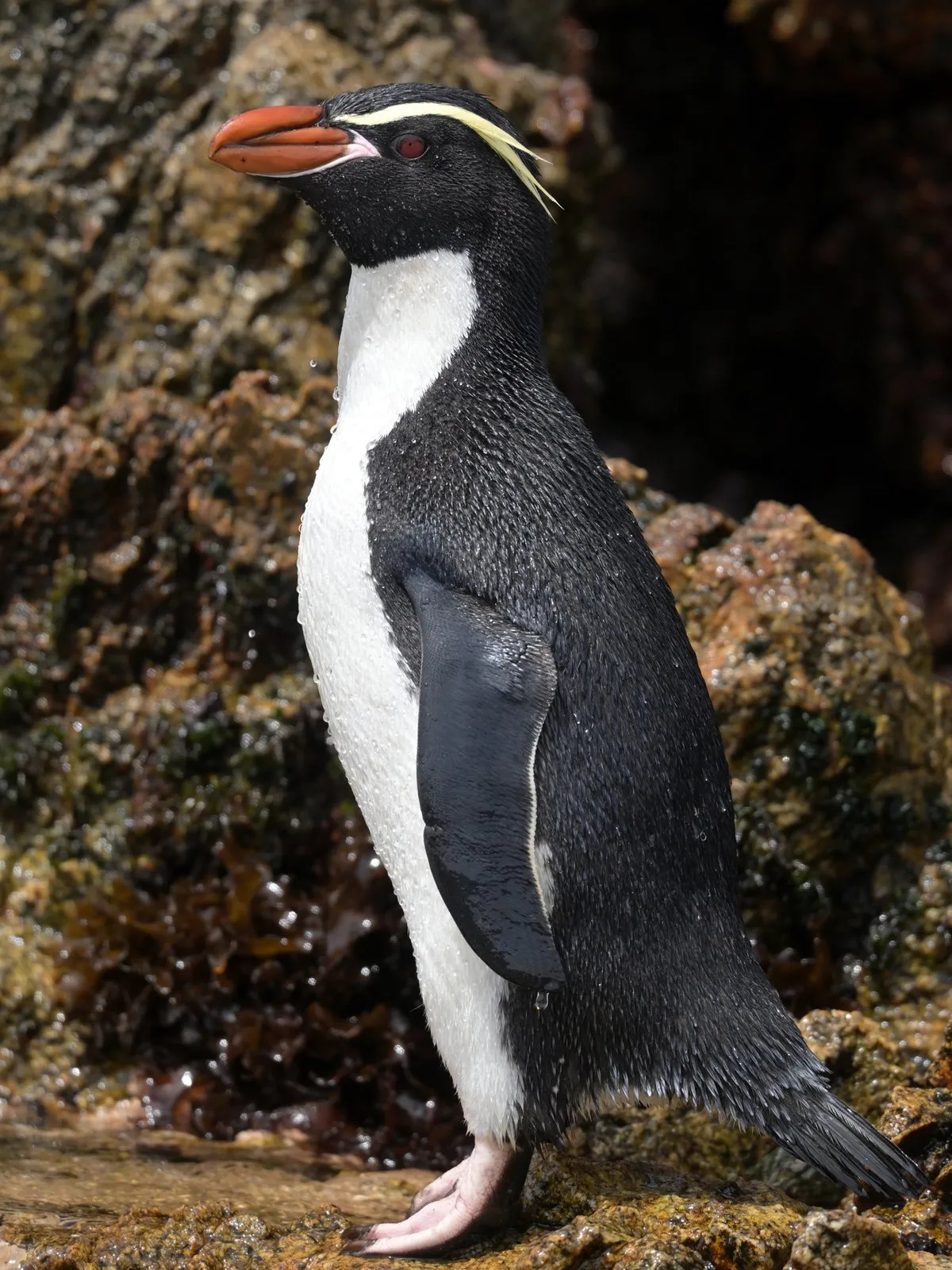
Snares Penguin
Scientific name Eudyptes robustus
Page last checked: 2026/11/01
A penguin that breeds only on the small Snares Islands south of New Zealand, raising its chicks in colonies under forest trees.
Key facts
- Length
51–61 cm
- Weight
2.3–4.3 kg
- Population
25,149 pairs (2013 survey)
- Range
It comes ashore only to breed and to molt, and otherwise lives at sea. During the breeding season it travels to feed around the Snares Islands and in the seas to the north, and as far as about 200 km to the east. In winter it heads west and lives mainly in the seas south of Tasmania and Australia. Some stray birds come ashore on the coasts of mainland New Zealand, the Chatham Islands, Tasmania and elsewhere, and most of them are molting.
It breeds only on the Snares Islands, about 200 km south of mainland New Zealand, which have an area of about 3 km². The main breeding sites are North East Island and the eastern side of Broughton Island, and a few hundred pairs also breed on the islets of the Western Chain, set apart to the west. Most colonies are under forest of Olearia (trees of the daisy family) or among low scrub.
Created with Grok
Features
A medium-sized crested penguin that breeds only on the Snares Islands. It is recognized by the bare pink skin at the base of its large, robust bill. It forms colonies under forest trees and often rests perched on branches that hang over the colony. While most other crested penguins are declining, it is unusual in having an almost stable population.
How to identify
- Bill: Larger and more robust than the Fiordland penguin's
- Base of the bill: Bare pink skin
Created with Grok
- It has a larger, more robust bill than the Fiordland penguin, with bare pink skin at the base of the bill.
- The Fiordland penguin has a broader yellow stripe above the eye and often shows whitish streaks on the cheeks.
- The erect-crested penguin is taller, and its crest stands up like a brush with the two sides nearly parallel when seen from the front, whereas the crest of the Snares penguin spreads in a V shape.
- The three species named rockhopper penguins, including the western and northern rockhopper penguins, have a smaller body and bill, redder eyes, and many black feathers mixed into the crest.
Chicks and juveniles
- Chick
- Bill: Blackish brown, cream-colored tip
- Head: Dark brown to the throat in the thick down
- Underparts: White
Created with Grok
A newly hatched chick is covered in down that is dark brown on the head, the back and sides of the neck, and the back, and whitish from below the throat down. It is later replaced by thick down, and the whole head becomes dark brown down to the throat and the underparts white. The bill is blackish brown with a cream-colored tip.
- Juvenile
- Crest: Short
- Bill: More slender, blackish brown
- Chin: Bluish gray to pale gray
Created with Grok
A newly fledged juvenile is smaller than an adult, with a more slender, blackish-brown bill. The crest is short, and the chin is bluish gray to pale gray. At one year old the bill becomes dull orange-brown.
Life
Chicks are fed mainly krill (small shrimp-like animals), with fish making up about 30% and squid about 10%. Adults are thought to eat more fish and squid. It catches prey by pursuit diving, and the deepest recorded dive is 120 m. After raising its chicks it goes to sea to feed heavily, returns to the islands to molt in March–April, leaves by May, and spends the winter after moving west as far as the seas south of Australia.
Breeding
Birds return to the colony in September, build a nest by lining a shallow hollow in the ground with mud, twigs, stones and the like, and lay two eggs from mid-September to mid-October. The second egg is larger; both parents take turns incubating for about 33 days, and both eggs hatch in about 60% of nests, but in most nests only one chick is raised. Chicks are guarded by a parent for about 3 weeks, then gather in groups with other chicks, and fledge at about 75 days old, around the end of January. On the islets of the Western Chain breeding is later, by a period given as about 6 weeks, or 15–44 days.
Other penguins
- King Penguin
- Emperor Penguin
- Adelie Penguin
- Chinstrap Penguin
- Gentoo Penguin
- Little Penguin
- African Penguin
- Magellanic Penguin
- Humboldt Penguin
- Galapagos Penguin
- Yellow-eyed Penguin
- Macaroni Penguin
- Royal Penguin
- Erect-crested Penguin
- Fiordland Penguin
- Snares Penguin
- Northern Rockhopper Penguin
- Western Rockhopper Penguin
- Eastern Rockhopper Penguin
Sources
- AviList v2026 (The Global Avian Checklist) (AviList Core Team, checked 2026/11/01)
Used for: Range and breeding sites - どんな種類がいるの?(ペンギン分類表、夏の企画展示 2019「のぞいてみよう!ペンギンワールド」) (国立極地研究所 南極・北極科学館, checked 2026/10/26)
Used for: How to identify - Snares Penguin Eudyptes robustus (Species factsheet) (BirdLife International, checked 2026/10/26)
Used for: Range and breeding sites, Features, Life, Breeding
Values from this source: Breeding is about 6 weeks later on the islets of the Western Chain - Snares crested penguin | pokotiwha (New Zealand Birds Online, checked 2026/10/09)
Used for: Length, Weight, Range and breeding sites, How to identify, Chicks and juveniles, Features, Life, Breeding
Values from this source: Breeding is about 6 weeks later on the islets of the Western Chain - Snares crested penguin (Department of Conservation, checked 2026/10/26)
Used for: Range and breeding sites, How to identify, Features, Breeding - Snares crested penguins Eudyptes robustus population estimates 2000–2013 (Hiscock & Chilvers, New Zealand Journal of Ecology 40(1): 108–113) (New Zealand Ecological Society (2016), checked 2026/10/09)
Used for: Population, Features
Values from this source: A count of nests with eggs - Snares penguin (Mattern & Wilson, State of Penguins, DOI: 10.36617/SoP.snares.2019-04) (State of Penguins (2019), checked 2026/10/09)
Used for: Range and breeding sites, Life, Breeding
Values from this source: Breeding is 15–44 days later on the islets of the Western Chain / 29,009 pairs in 2013 (the total number of nests is taken as the number of pairs) - Snares Penguin Eudyptes robustus (Marchant & Higgins (eds.), Handbook of Australian, New Zealand and Antarctic Birds, Vol. 1, excerpt) (Oxford University Press (1990), checked 2026/10/26)
Used for: Length, Weight, How to identify, Chicks and juveniles, Life, Breeding