
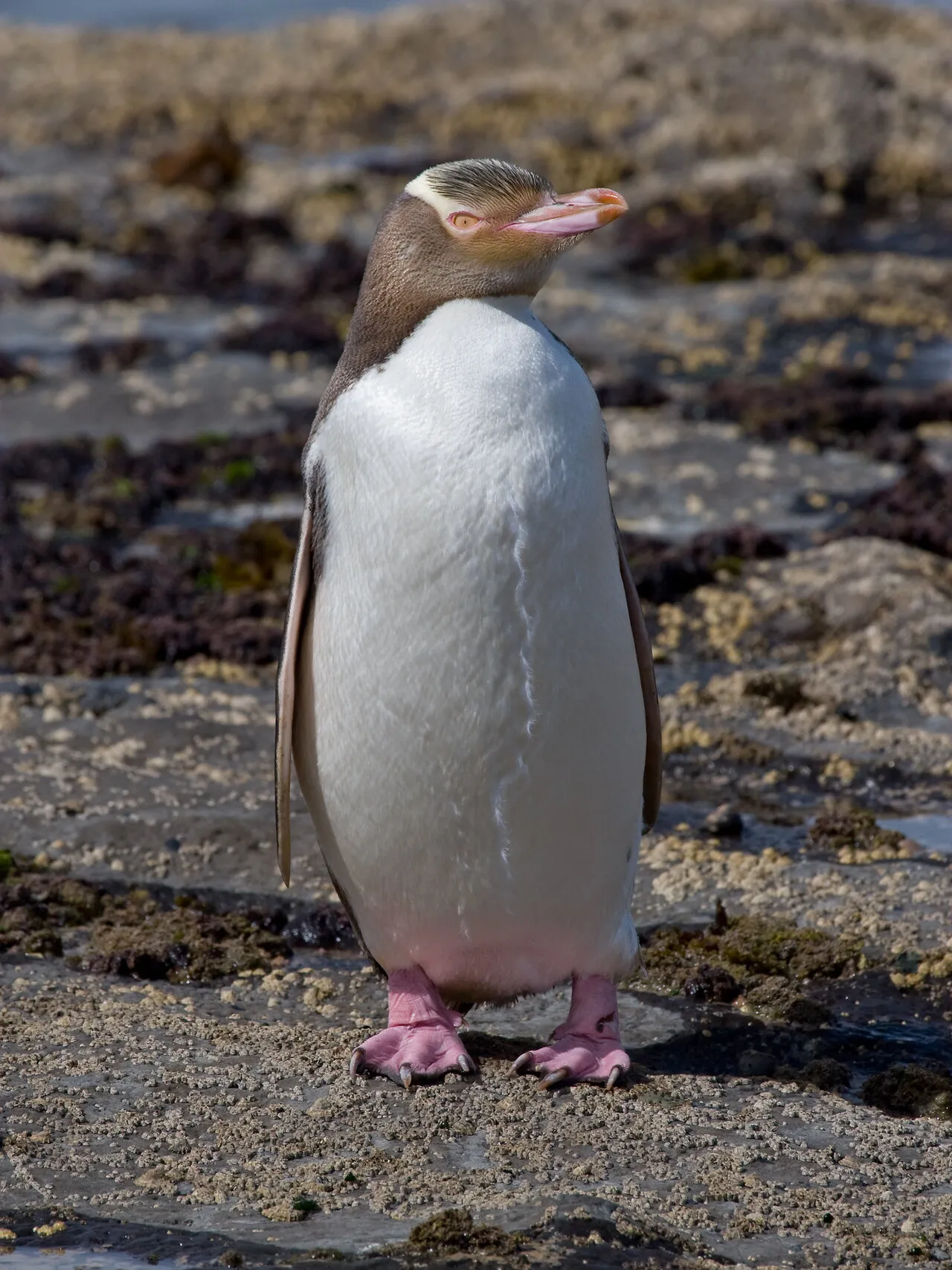
Yellow-eyed Penguin
Scientific name Megadyptes antipodes
Page last checked: 2026/11/01
A penguin found only in New Zealand, recognized by its yellow eyes and the pale yellow band that runs from around the eyes around the back of the head. It does not nest in colonies; pairs nest apart in forest and scrub, out of sight of neighboring nests.
Key facts
- Length
65–72 cm
- Weight
5–6 kg
- Population
2,800 mature individuals (2020 survey)
- Range
Adults stay near their breeding sites all year round and feed in offshore waters. Juveniles disperse north and may travel as far as Cook Strait, between the South Island and the North Island. Stray birds have also been recorded in the Bay of Plenty in the North Island and at the Chatham Islands and the Snares Islands.
It breeds on the southeast coast of the South Island of New Zealand, on Stewart Island and its surrounding islands, and on the subantarctic Auckland Islands and Campbell Island. On the South Island there are breeding sites in four areas, namely the Catlins, Otago Peninsula, North Otago and Banks Peninsula, with only a few pairs on Banks Peninsula. Numbers are highest on the subantarctic Auckland Islands and Campbell Island. Nests are made in coastal forest and scrub, and also in pasture and under planted trees.
Created with Grok
Features
The largest penguin that breeds on the New Zealand mainland, and found nowhere else. It is regarded as one of the rarest penguins in the world. Unlike most penguins it does not form dense colonies; each pair nests apart in forest or scrub, out of sight of neighboring nests. Its Māori name, hoiho, means "noise shouter" and refers to its shrill calls at the breeding sites.
How to identify
- Eye: Yellow
- Bill: Long and slender
- Yellow band: From around the eyes around the back of the head
- Head and neck: Sides of the head and foreneck pale yellowish brown
Created with Grok
- The eyes are yellow, and a band of pale yellow feathers runs from around the eyes all the way around the back of the head.
- The forehead, chin and cheeks are black flecked with yellow, and the sides of the head and the foreneck are pale yellowish brown.
- It has no crest above the eyes.
- The bill is long and slender; its color differs between sources, given as reddish brown and pale cream, or as reddish brown at the tip and on top and pale pink below.
- The feet are pink above and blackish on the soles.
- No similar species occurs in New Zealand, and adults are almost unmistakable even in the middle of the molt.
Chicks and juveniles
- Chick
Until about 3–4.5 months old
- Down: Dark brown and thick
Created with Grok
Chicks are thickly covered in dark brown down until they fledge.
- Juvenile
From about 3–4.5 months old until about 12–16 months old
- Eye: Paler than in adults
- Head: Pale at the back, no yellow band
Created with Grok
Juveniles lack the yellow band from around the eyes to the back of the head, and their eyes and the back of the head are paler than in adults. They gain adult plumage, with the yellow band, at the molt in their second year.
Life
It dives for small fish that live near the seabed, in waters about 2–25 km offshore, and also eats squid. It dives to about 120 m; dives are given as sometimes deeper than 120 m, up to about 150 m, or up to 160 m. In recent years, partly because of rising sea temperatures and fishing, red cod, an important prey in the 1980s, has declined, and the birds now more often eat the less nutritious blue cod (both are fish of New Zealand waters). Adults stay near their breeding sites all year round and molt on land in autumn.
Breeding
Pairs appear at their nest sites as early as July or August and build a shallow bowl-shaped nest of twigs, grass and leaves in a well-hidden place such as under scrub. Two eggs are laid in September or October, and both parents take turns incubating them for 39–51 days. Chicks hatch mainly in November; at first one parent stays at the nest to guard them, and later both parents go to sea to find food. Chicks fledge about three and a half months after hatching, with the fledging period given as February–April, or mid-February to mid-March.
Other penguins
- King Penguin
- Emperor Penguin
- Adelie Penguin
- Chinstrap Penguin
- Gentoo Penguin
- Little Penguin
- African Penguin
- Magellanic Penguin
- Humboldt Penguin
- Galapagos Penguin
- Yellow-eyed Penguin
- Macaroni Penguin
- Royal Penguin
- Erect-crested Penguin
- Fiordland Penguin
- Snares Penguin
- Northern Rockhopper Penguin
- Western Rockhopper Penguin
- Eastern Rockhopper Penguin
Sources
- AviList v2026 (The Global Avian Checklist) (AviList Core Team, checked 2026/11/01)
Used for: Range and breeding sites - Yellow-eyed penguin | Hoiho (Seddon & Michaux 2022) (New Zealand Birds Online, checked 2026/10/25)
Used for: Length, Weight, Range and breeding sites, Population, How to identify, Chicks and juveniles, Features, Life, Breeding
Values from this source: The bill is reddish brown and pale cream / Chicks fledge in February–April / Chicks fledge at 106 days old on average - Yellow-eyed Penguin Megadyptes antipodes (Species factsheet) (BirdLife International, checked 2026/10/26)
Used for: Range and breeding sites, Population, Life, Breeding
Values from this source: Sometimes dives deeper than 120 m / Chicks fledge from mid-February to mid-March / 2,600–3,000 mature individuals, an estimate from the 2020 assessment, combining surveys from each site - Yellow-eyed penguin/hoiho (Department of Conservation (New Zealand), checked 2026/10/09)
Used for: Range and breeding sites, Features, Life
Values from this source: Dives to 160 m at the deepest / 4,000–5,000 mature individuals in 2019 - Yellow-eyed penguin on Campbell Island (Moore & Moffat, Science and Research Internal Report No. 58) (Department of Conservation (New Zealand, 1990), checked 2026/10/09)
Used for: Length, Weight, Range and breeding sites, Chicks and juveniles, Features, Life, Breeding - Yellow-eyed penguin / Hoiho Megadyptes antipodes (Otago Regional Council (2025), checked 2026/10/09)
Used for: Length, Weight, Range and breeding sites, Life - Hoiho Facts (About the yellow-eyed penguin) (Yellow-eyed Penguin Trust, checked 2026/10/25)
Used for: How to identify, Chicks and juveniles, Features, Life, Breeding
Values from this source: The bill is reddish brown at the tip and on top and pale pink below / Dives to about 150 m at the deepest / Adult plumage is gained at 14–16 months old, after the juvenile molts - Megadyptes antipodes (yellow-eyed penguin) (Animal Diversity Web (University of Michigan Museum of Zoology), checked 2026/10/25)
Used for: Chicks and juveniles
Values from this source: Chicks fledge at 3–4.5 months old (3.5 months on average) / The yellow feathers grow at the molt at about 1 year old