
Erect-crested Penguin
Scientific name Eudyptes sclateri
Page last checked: 2026/11/01
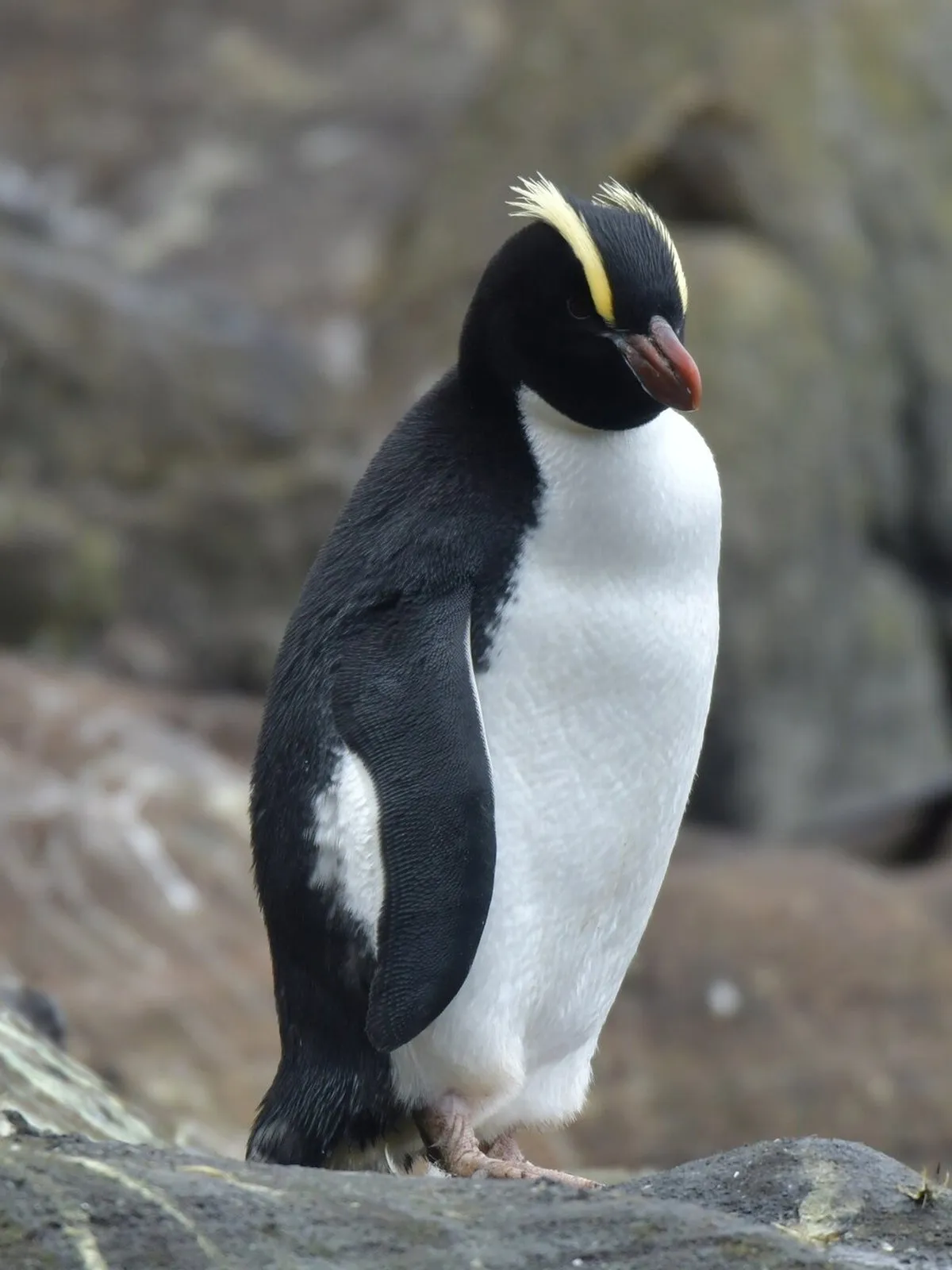
A penguin recognized by its short, upright yellow crest, breeding mainly on the Antipodes Islands and the Bounty Islands, off the southeast of New Zealand. The size difference between its two eggs is the greatest of any bird, and it is regarded as the least studied of all penguins.
Key facts
- Length
65–67 cm
- Weight
2.9–7 kg
- Population
60,226 pairs (2011 survey)
- Range
The erect-crested penguin is thought to live at sea outside the breeding season, but where it goes is poorly known; it is believed to be found mainly from the seas southeast of New Zealand north to the Chatham Islands. In winter it reaches the waters off the east coast of the South Island of New Zealand, and almost every summer some birds come ashore on the east coast of the South Island to molt. It also appears at Campbell Island, the Snares Islands and the Chatham Islands, and stray birds occasionally reach the southern coast of Australia, the Kerguelen Islands and the Falkland Islands.
Almost all birds breed on the Antipodes Islands and the Bounty Islands, off the southeast of New Zealand. On Antipodes Island it forms colonies on rocky coasts, and on the Bounty Islands, which have almost no vegetation, it nests wherever space is not taken by fur seals or Salvin's albatrosses. In the middle of the 20th century one pair was recorded attempting to breed on Otago Peninsula on the New Zealand mainland, but in recent years there have been no breeding records outside these two island groups.
Created with Grok
Features
One of several similar crested penguins found only south of New Zealand. The size difference between its eggs is the greatest of any bird; the second egg is said to be 81% larger on average than the first, or 85% heavier by weight. The small first egg is almost always lost early, and only one chick is raised. Because its breeding sites are remote and hard to reach, it is regarded as the least studied of all penguins.
How to identify
- Crest: Short and upright
- Crown: Looks domed
- Yellow band: Starts between the nostril and the gape, rising diagonally above the eye
- Base of the bill: Bluish-white skin
Created with Grok
- The broad yellow band above the eye becomes a short, upright crest; the upright crest tells it from the other crested penguins.
- In the similar Snares penguin the two crests spread in a V shape when seen from the front, but in this species they are almost parallel.
- The yellow band starts between the nostril and the gape and rises diagonally above the eye, unlike the band of the Snares penguin, which starts near the nostril and runs back almost in line with the bill.
- The skin around the base of the bill is bluish white, not pinkish as in the Snares penguin.
- It is slightly larger than the Snares penguin, and in profile the chin looks large and the crown looks domed.
Chicks and juveniles
- Chick
- Bill: Blackish brown
- Head, neck and back: Dark brown
- Underparts: Whitish
Created with Grok
A newly hatched chick is covered in down that is dark brown on the head, the back and sides of the neck, and the back, and whitish from below the throat down. It is later replaced by thick down, and the whole head becomes dark brown down to the throat. The bill is blackish brown, and the tip is said to turn cream-colored around the time the down is shed.
- Juvenile
- Band above the eye: Looks almost white
- Bill: Smaller and more blackish than an adult's
- Chin: Often whitish
Created with Grok
Juveniles have a smaller, more blackish bill than adults, the band above the eye is so pale that it looks almost white, and the chin is often whitish.
Life
It comes ashore only to breed and to molt. Its diet is poorly studied; it is said to eat small crustaceans (relatives of shrimps and crabs) and squid, or is thought to eat krill (small shrimp-like animals), squid and fish. Near its breeding islands it feeds in groups. The molt takes about 4 weeks, during which it stays ashore and lives only on the body fat stored beforehand, so it loses much weight.
Breeding
Birds return to the colony in September and lay two eggs from early October. The second egg is laid a few days after the first; the small first egg is almost always lost early, and only the second is incubated. The nest is described as a shallow hollow lined with pebbles and the like, but in a 1998 survey on Antipodes Island most nests had no nest material and the eggs were laid directly on rock or ground. Once the clutch is complete it is incubated mainly by the female, both parents care for the chick after it hatches, and chicks leave the island mostly around the end of January.
Other penguins
- King Penguin
- Emperor Penguin
- Adelie Penguin
- Chinstrap Penguin
- Gentoo Penguin
- Little Penguin
- African Penguin
- Magellanic Penguin
- Humboldt Penguin
- Galapagos Penguin
- Yellow-eyed Penguin
- Macaroni Penguin
- Royal Penguin
- Erect-crested Penguin
- Fiordland Penguin
- Snares Penguin
- Northern Rockhopper Penguin
- Western Rockhopper Penguin
- Eastern Rockhopper Penguin
Sources
- AviList v2026 (The Global Avian Checklist) (AviList Core Team, checked 2026/11/01)
Used for: Range and breeding sites - Erect-crested penguin | Tawaki nana hī (New Zealand Birds Online, checked 2026/10/09)
Used for: Length, Weight, Range and breeding sites, How to identify, Chicks and juveniles, Features, Life, Breeding
Values from this source: The second egg is 81% larger on average than the first / Eats small crustaceans and squid / The nest is a shallow hollow lined with pebbles and the like - Erect-crested Penguin Eudyptes sclateri (Marchant & Higgins (eds.), Handbook of Australian, New Zealand and Antarctic Birds, Vol. 1, excerpt) (Oxford University Press (1990), checked 2026/10/26)
Used for: Length, Weight, Range and breeding sites, How to identify, Chicks and juveniles, Features, Life, Breeding - Erect-crested Penguin Eudyptes sclateri (Species factsheet) (BirdLife International, checked 2026/10/26)
Used for: Range and breeding sites, Population, Features, Life
Values from this source: The second egg is 85% heavier than the first / Thought to eat krill, squid and fish / The number of nests is the total of 34,226 on the Antipodes Islands in 2011 and about 26,000 on the Bounty Islands, counting one nest as one pair - Eudyptes sclateri, Erect-crested penguin (SeaLifeBase, checked 2026/10/09)
Used for: Length - The breeding biology of erect-crested penguins, Eudyptes sclateri: Hormones, behavior, obligate brood reduction and conservation (Davis et al., PLoS ONE 17(10): e0275106) (PLOS (2022), checked 2026/10/09)
Used for: Weight, Range and breeding sites, Features, Breeding
Values from this source: Most nests had no nest material in a 1998 survey on Antipodes Island - Call to keep distance from rare penguin (Matthew Littlewood) (Otago Daily Times (2025-02-14), checked 2026/10/09)
Used for: Life