
Fiordland Penguin
Scientific name Eudyptes pachyrhynchus
Page last checked: 2026/11/01
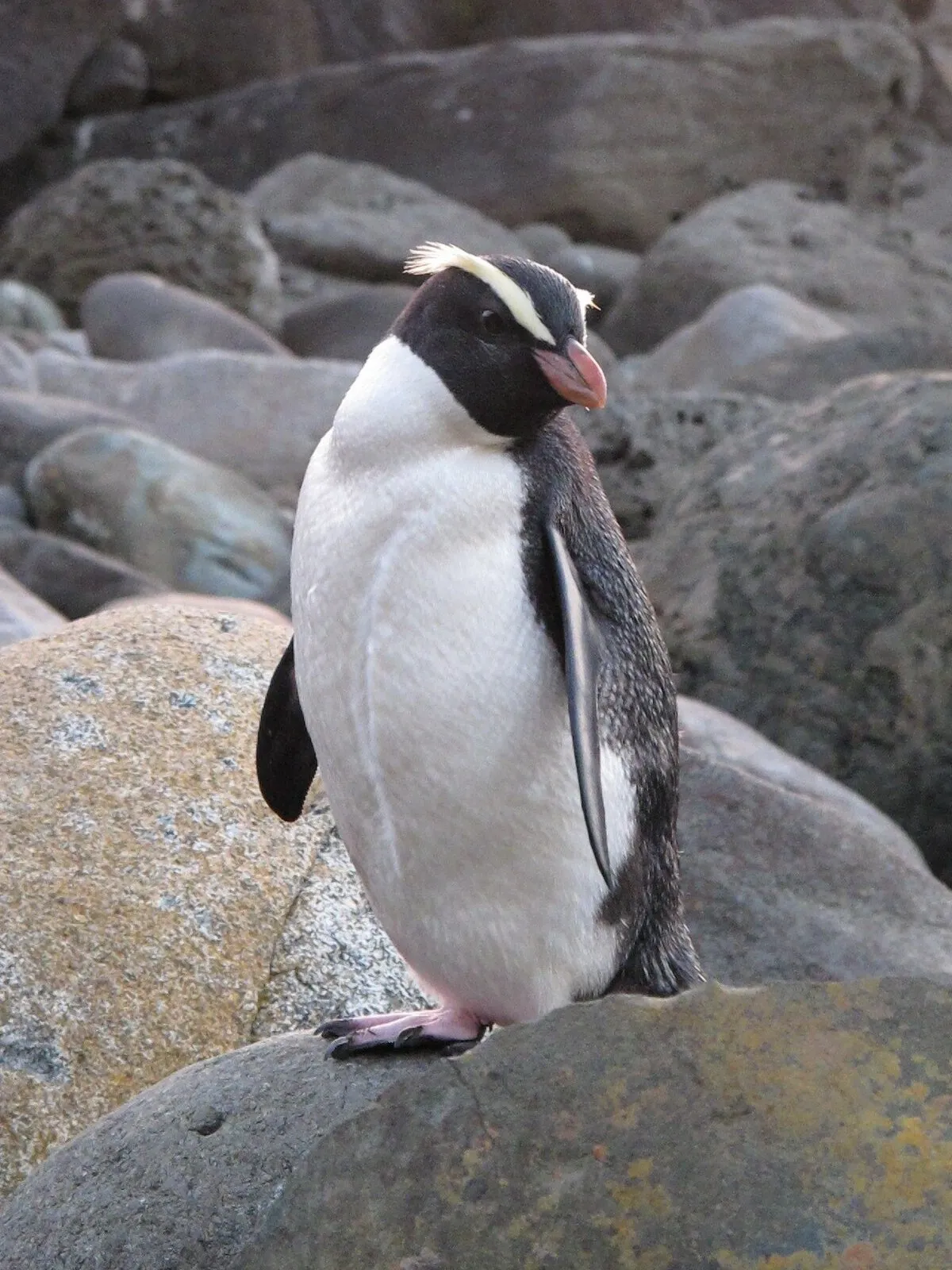
A penguin with a yellow crest that droops from above the eye to the neck. It raises its chicks hidden in forest and sea caves in the southwest of the South Island of New Zealand and around Stewart Island.
Key facts
- Length
55–60 cm
- Weight
2.5–4.9 kg
- Population
31,250 mature individuals (2019 survey)
- Range
It lives at sea except when breeding and molting. Tracking studies have shown birds traveling before the molt to subantarctic waters southeast of the South Island and to the seas south of Tasmania, and it is also said to travel to subantarctic waters up to 3,000 km southwest of New Zealand. Around the molt it is also seen on coasts throughout the South Island and at the Snares Islands, the Auckland Islands, Campbell Island and Macquarie Island. It also often reaches Tasmania in Australia.
Its colonies are scattered along the southwest coast of the South Island of New Zealand, from Bruce Bay in South Westland to Coal Island in southern Fiordland. It also breeds on Solander Island, Codfish Island (Whenua Hou), and Stewart Island and its nearby islets, south of the South Island. Nests are made in temperate rainforest and scrub, in sea caves and under rocks.
Created with Grok
Features
Endemic to New Zealand, and the only crested penguin that breeds on the New Zealand mainland. Because it nests hidden in places that are hard for people to reach, such as temperate rainforest and sea caves, it is a very difficult penguin to count. It is very timid and may leave its nest when startled by people. In Māori it is called tawaki.
How to identify
- Crest: Like a broad eyebrow, over the eye and drooping down the neck
- Base of the bill: No pink skin, only a thin line of black skin
- Cheeks: Often 3–6 whitish streaks
Created with Grok
- A crest like a broad yellow eyebrow runs from the base of the bill over the eye and droops down the neck.
- Three to six whitish streaks are often visible on the cheeks.
- Unlike the Snares penguin, it has no pink skin at the base of the bill, only a thin line of black skin.
- Its crest does not stand upright like that of the erect-crested penguin, and its eyebrow stripe does not start thin like those of the western and northern rockhopper penguins.
Chicks and juveniles
- Chick
Until about 2.5 months old
- Back, neck and throat: Dark brown
- Belly: Creamy white
Created with Grok
A newly hatched chick is covered in down that is dark brown on the back, neck and throat and creamy white on the belly.
- Juvenile
From about 2.5 months old
- Eyebrow stripe: Short, thin and pale yellow
- Chin and throat: Mottled whitish
- Back: Bluish when newly fledged
Created with Grok
In juveniles the eyebrow stripe is short, thin and pale yellow, and the chin and throat are mottled whitish. The back of a newly fledged juvenile is distinctly bluish; it turns black with wear and brown before the molt.
Life
During the breeding season it eats squid, krill (small shrimp-like animals) and fish, and its diet varies greatly from place to place. In a study on the west coast of the South Island, squid made up 85% and krill 13%, whereas on Codfish Island fish made up 85%. Parents raising chicks in Milford Sound feed almost entirely within the fiord (a deep inlet carved by a glacier). After breeding it spends a little over two months at sea fattening up, returns to the colony and uses much of the weight it gained during a molt of about 3 weeks, and then goes back to sea.
Breeding
Birds return to the colony from mid-June to early July, and in July–August lay two eggs 3–6 days apart, the first smaller than the second. Both parents take turns incubating for 31–36 days, and unlike in other crested penguins the female leaves first on the first long feeding trip. Chicks hatch in September, and usually only one is raised, but in years of plentiful food up to 12% of pairs raise two. For about 3 weeks after hatching the male guards the chick and the female brings food; chicks then form small groups and fledge at about 75 days old, from mid-November to early December.
Other penguins
- King Penguin
- Emperor Penguin
- Adelie Penguin
- Chinstrap Penguin
- Gentoo Penguin
- Little Penguin
- African Penguin
- Magellanic Penguin
- Humboldt Penguin
- Galapagos Penguin
- Yellow-eyed Penguin
- Macaroni Penguin
- Royal Penguin
- Erect-crested Penguin
- Fiordland Penguin
- Snares Penguin
- Northern Rockhopper Penguin
- Western Rockhopper Penguin
- Eastern Rockhopper Penguin
Sources
- AviList v2026 (The Global Avian Checklist) (AviList Core Team, checked 2026/11/01)
Used for: Range and breeding sites - どんな種類がいるの?(ペンギン分類表、夏の企画展示 2019「のぞいてみよう!ペンギンワールド」) (国立極地研究所 南極・北極科学館, checked 2026/10/26)
Used for: How to identify - Fiordland Penguin Eudyptes pachyrhynchus (Species factsheet) (BirdLife International, checked 2026/10/26)
Used for: Range and breeding sites, Population, Features, Life, Breeding
Values from this source: Travels to subantarctic waters up to 3,000 km southwest of New Zealand / The 2020 assessment adopts the estimate reported in 2019 (12,500–50,000 mature individuals) - Fiordland crested penguin | tawaki (New Zealand Birds Online, checked 2026/10/25)
Used for: Length, Weight, Range and breeding sites, How to identify, Chicks and juveniles, Features, Life, Breeding
Values from this source: Chicks fledge at about 75 days old - Fiordland crested penguin/tawaki (Department of Conservation, checked 2026/10/09)
Used for: Features, Breeding - 74. Fiordland crested penguin | tawaki (Otago Regional Council (2025), checked 2026/10/09)
Used for: Length, Weight - Fiordland penguin / tawaki Eudyptes pachyrhynchus (Mattern & Wilson, State of Penguins, DOI: 10.36617/SoP.tawaki.2019-04) (State of Penguins (2019), checked 2026/10/09)
Used for: Range and breeding sites, Population, Features, Life, Breeding
Values from this source: 12,500–50,000 mature individuals, an estimate reported in 2019, extrapolated from new surveys of some areas - Fiordland Penguin Eudyptes pachyrhynchus (Marchant & Higgins (eds.), Handbook of Australian, New Zealand and Antarctic Birds, Vol. 1, excerpt) (Oxford University Press (1990), checked 2026/10/26)
Used for: Length, Weight, How to identify, Chicks and juveniles, Life, Breeding - Eudyptes pachyrhynchus (Fiordland penguin) (Animal Diversity Web (University of Michigan Museum of Zoology), checked 2026/10/25)
Used for: Length, Chicks and juveniles
Values from this source: Chicks molt and go to sea at about 75 days old