
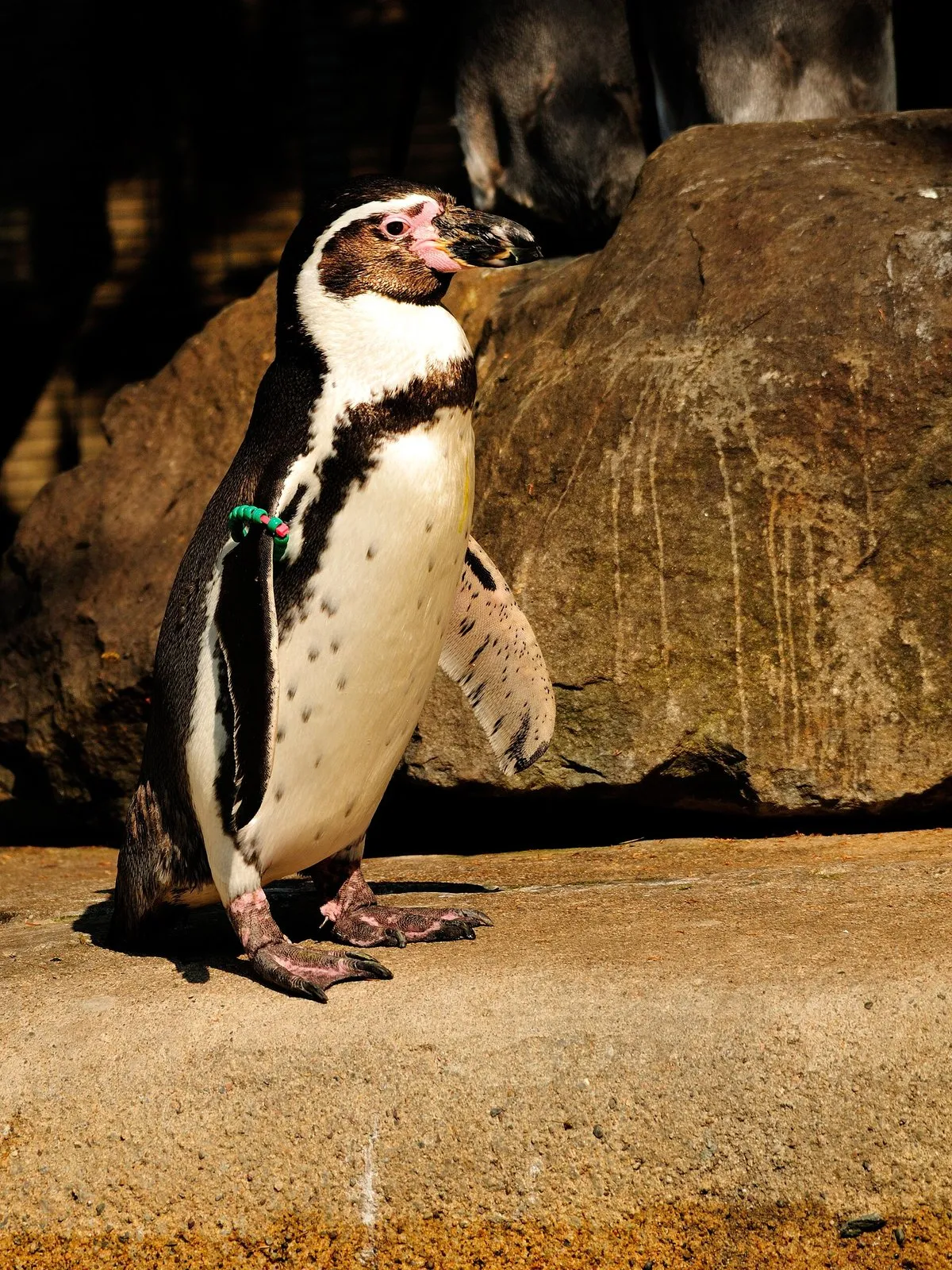
Humboldt Penguin
Scientific name Spheniscus humboldti
Page last checked: 2026/11/01
A penguin found only along the coasts of Peru and Chile, with a single black band across its breast. It raises its chicks in burrows dug into guano (hardened layers of seabird droppings) and similar places.
Key facts
- Length
56–70 cm
- Weight
4–5 kg
- Population
23,800 mature individuals (2017 survey)
- Range
It lives along the Pacific coast of South America, in waters fed by the cold, nutrient-rich Humboldt Current. It is found along the coast from Foca Island in northern Peru to Guafo Island in southern Chile. After the molt, some birds move north.
It breeds on islands and rocky coasts, with colonies scattered between Punta Aguja in Peru and Metalqui Island in Chile. The main colonies are Punta San Juan and Santa Rosa Island in Peru, and Pan de Azúcar Island, Chañaral Island, Choros Island, Tilgo Island and Pájaros Island in Chile.
Created with Grok
Features
A penguin found only along the coasts of Peru and Chile, where the cold Humboldt Current flows. Like other penguins of temperate regions, it has bare skin around the eyes and at the base of the bill. It is very sensitive to human presence, and breeding success falls sharply at colonies that people visit often.
How to identify
- Base of the bill: Pink skin reaching around the eye
- White line on the head: From the eye around the ear, joining at the throat
- Breast band: One black band
Created with Grok
- It has a single black breast band, not two or more like the Magellanic penguin.
- The white line on the head runs from the eye around the ear and joins at the throat.
- There is bare pink skin from the base of the bill to around the eye.
Chicks and juveniles
- Chick
Until about 2–3.5 months old
- Plumage: Grayish brown and white
Created with Grok
Chicks are covered in grayish-brown and white plumage.
- Juvenile
From about 2–3.5 months old
- Head: Entirely dark
- Breast: No black band
Created with Grok
Juveniles have an entirely dark head and no black breast band.
Life
It feeds mainly on schooling fish such as the Peruvian anchoveta, and also eats squid. While raising chicks it feeds near the colony. Most of its dives are shallow, close to the surface. The molt is given as mainly January–February, or usually January, and during it the birds stay ashore without eating.
Breeding
Breeding can be seen all year round, but there are said to be two peaks, in April–July and August–December, or in April and August–September. Nests are made in burrows dug into guano, in rock crevices and in sea caves. It usually lays two eggs, and both parents take turns incubating them for about 40–42 days. Chicks stay in the burrow for some time and do not form groups with other chicks, and they are said to fledge at 10–12 weeks, or 10–13 weeks.
Other penguins
- King Penguin
- Emperor Penguin
- Adelie Penguin
- Chinstrap Penguin
- Gentoo Penguin
- Little Penguin
- African Penguin
- Magellanic Penguin
- Humboldt Penguin
- Galapagos Penguin
- Yellow-eyed Penguin
- Macaroni Penguin
- Royal Penguin
- Erect-crested Penguin
- Fiordland Penguin
- Snares Penguin
- Northern Rockhopper Penguin
- Western Rockhopper Penguin
- Eastern Rockhopper Penguin
Sources
- AviList v2026 (The Global Avian Checklist) (AviList Core Team, checked 2026/11/01)
Used for: Range and breeding sites - Humboldt Penguin Spheniscus humboldti (Species factsheet) (BirdLife International, checked 2026/10/26)
Used for: Range and breeding sites, Population, Features, Life, Breeding
Values from this source: The molt is mainly in January–February / Two breeding peaks, in April–July and August–December / At most about 23,800 mature individuals, the total of 10,200 in Chile and 13,600 in Peru (including juveniles) in 2017 - Spheniscus humboldti, Humboldt penguin (Heidi Nissley) (Animal Diversity Web (University of Michigan Museum of Zoology), checked 2026/10/25)
Used for: Length, Weight, Range and breeding sites, How to identify, Chicks and juveniles, Features, Life, Breeding
Values from this source: The molt is usually in January / Breeding peaks in April and August–September / Chicks fledge at 10–12 weeks - Humboldt Penguin (SeaWorld Parks & Entertainment, checked 2026/10/09)
Used for: Length, Weight, How to identify, Features, Breeding
Values from this source: The species was named after Humboldt - Humboldt penguin guide: where they live, what they eat and how they got their name (Ursula Clare Franklin) (Discover Wildlife (Our Media), checked 2026/10/25)
Used for: Length, Weight, How to identify, Chicks and juveniles, Life, Breeding
Values from this source: Chicks fledge at 10–13 weeks / Named after the Humboldt Current, which is named after Humboldt