
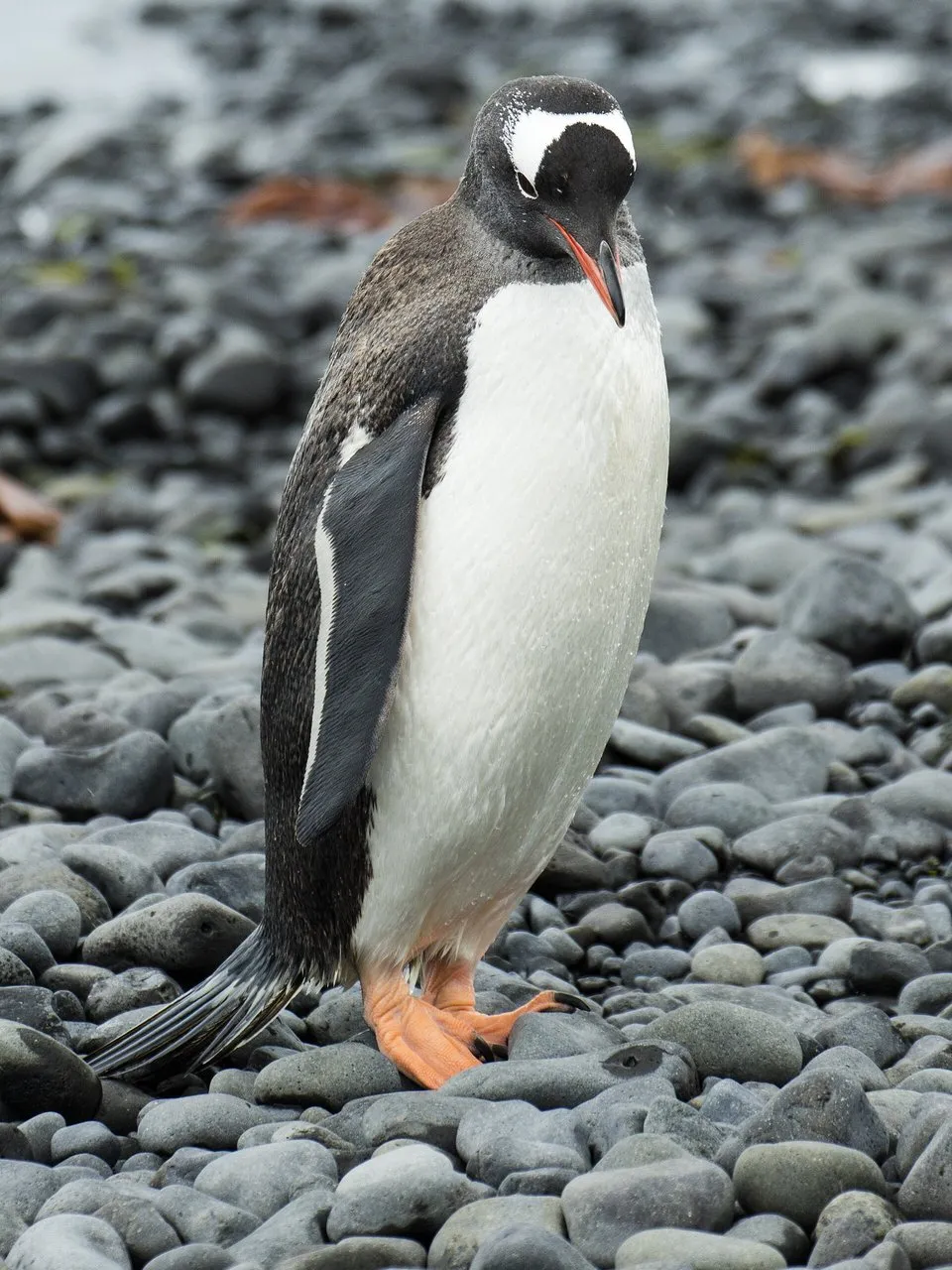
Gentoo Penguin
Scientific name Pygoscelis papua
Page last checked: 2026/11/01
A penguin recognized by the white marking above its eyes and its bright orange bill. It lives on the Antarctic Peninsula and subantarctic islands, and most birds stay around their breeding sites all year round.
Key facts
- Length
75–81 cm
- Weight
4–8 kg
- Population
432,144 pairs (2020 survey)
- Range
Many colonies are occupied all year round, and most birds do not travel far from their breeding sites. They are thought to spend the winter mostly in coastal waters. Stray birds have occasionally been recorded in New Zealand.
It breeds on the Antarctic Peninsula, in the South Shetland Islands, the South Orkney Islands and the South Sandwich Islands, and on many subantarctic islands. The main breeding sites are the Falkland Islands, South Georgia and the Antarctic Peninsula, and there are also colonies on the Kerguelen Islands, the Crozet Islands, Heard Island, Macquarie Island, the Prince Edward Islands, and islands around Tierra del Fuego in Argentina. On the Antarctic Peninsula its breeding range is expanding southward. Nests are built on flat beaches, among grass and on gentle slopes, and on the Antarctic Peninsula on low gravel beaches and similar ground.
Created with Grok
Features
It is regarded as the third-largest penguin, though one source ranks it joint third with the yellow-eyed penguin. Its closest relatives are the Adelie penguin and the chinstrap penguin. Body size varies widely by region, and birds on the Antarctic Peninsula are smaller than those on the subantarctic islands. Its colonies are smaller than those of the other species in its genus; the largest is said to hold about 6,000 pairs, although one source mentions colonies of 12,000 pairs.
How to identify
- Above the eye: White triangles joined across the head
- Bill: Reddish orange, black ridge and tip on the upper mandible
- Tail: Long, swings from side to side
Created with Grok
- It has a white triangular marking above each eye, and the two are joined by a thin white band across the top of the head.
- The bill is bright reddish orange, with a black ridge and tip on the upper mandible.
- No other penguin has both a bright orange bill and white feathers above the eyes.
- The tail is long and swings from side to side as the bird walks.
Chicks and juveniles
- Chick
Until about 2–4 months old
- Upperparts: Dark brown from head to back
- Base of the flippers: White down
- Underparts: White from the chin down
Created with Grok
A newly hatched chick is covered in down that is dark brown on the upperparts, from the head to the back, and white on the underparts, from the chin down. The down that later replaces it is thicker, with a large patch of white down at the base of the flippers.
- Juvenile
From about 2–4 months old
- Marking above the eye: Not fully joined to the band on the head
- Around the eye: White ring thin or absent
- Chin and throat: Mottled dull white or brownish gray
Created with Grok
Juveniles look like adults, but the white triangular marking above the eye is not fully joined to the band across the head and in most birds does not reach the eye. The white ring around the eye is thin or absent. The chin and throat are mottled dull white or brownish gray.
Life
Its diet changes with the season and the place, and it eats whatever is available at the time among crustaceans such as krill (crustaceans are relatives of shrimps and crabs), small fish and squid. It usually feeds in coastal waters near the colony and does not travel far. Eggs are taken by skuas, and full-grown birds are hunted by leopard seals.
Breeding
Its breeding cycle is more variable than that of other penguins, and the location of a colony also shifts a little every year. It builds a nest of piled pebbles or grass on a beach or among grass, lays two eggs, and both parents take turns incubating them for about 5 weeks (about 35 days, or 34–37 days). Chicks are said to begin forming groups with other chicks at about 26 days old, or to spend 29 days in the nest on average. The time to fledging is given as 80–90 days, or 62–82 days in the south and 85–117 days in the north.
Other penguins
- King Penguin
- Emperor Penguin
- Adelie Penguin
- Chinstrap Penguin
- Gentoo Penguin
- Little Penguin
- African Penguin
- Magellanic Penguin
- Humboldt Penguin
- Galapagos Penguin
- Yellow-eyed Penguin
- Macaroni Penguin
- Royal Penguin
- Erect-crested Penguin
- Fiordland Penguin
- Snares Penguin
- Northern Rockhopper Penguin
- Western Rockhopper Penguin
- Eastern Rockhopper Penguin
Sources
- AviList v2026 (The Global Avian Checklist) (AviList Core Team, checked 2026/11/01)
Used for: Range and breeding sites - ジェンツーペンギン (アドベンチャーワールド, checked 2026/10/10)
Used for: Length, Weight, Breeding - Gentoo penguin (New Zealand Birds Online, checked 2026/10/25)
Used for: Length, Weight, Range and breeding sites, How to identify, Chicks and juveniles, Features, Life, Breeding
Values from this source: Joint third-largest with the yellow-eyed penguin / There are colonies of 12,000 pairs / Eggs are incubated for about 35 days / Chicks spend 29 days in the nest on average / Chicks fledge at 62–82 days in the south and 85–117 days in the north - Gentoo penguin (Australian Antarctic Division (Australian Antarctic Program), checked 2026/10/25)
Used for: Weight, Range and breeding sites, How to identify, Chicks and juveniles, Features, Life, Breeding
Values from this source: The third-largest penguin / Eggs are incubated for 34–37 days / Chicks begin forming groups at about 26 days old / Chicks fledge at 80–90 days - Gentoo Penguin Pygoscelis papua (Species factsheet) (BirdLife International, checked 2026/10/26)
Used for: Range and breeding sites, Features, Life, Breeding
Values from this source: The largest colony holds about 6,000 pairs - Pygoscelis papua, Gentoo penguin (SeaLifeBase, checked 2026/10/24)
Used for: Length, Weight - Update on the global abundance and distribution of breeding Gentoo Penguins (Pygoscelis papua) (Herman et al., Polar Biology 43: 1947–1956) (Springer (2020), checked 2026/10/10)
Used for: Range and breeding sites, Population
Values from this source: About 432,000 breeding pairs (338,059–534,114) / An estimate published in 2020, combining surveys from each site - Gentoo Penguin Pygoscelis papua (Marchant & Higgins (eds.), Handbook of Australian, New Zealand and Antarctic Birds, Vol. 1, excerpt) (Oxford University Press (1990), checked 2026/10/26)
Used for: Length, How to identify, Chicks and juveniles