
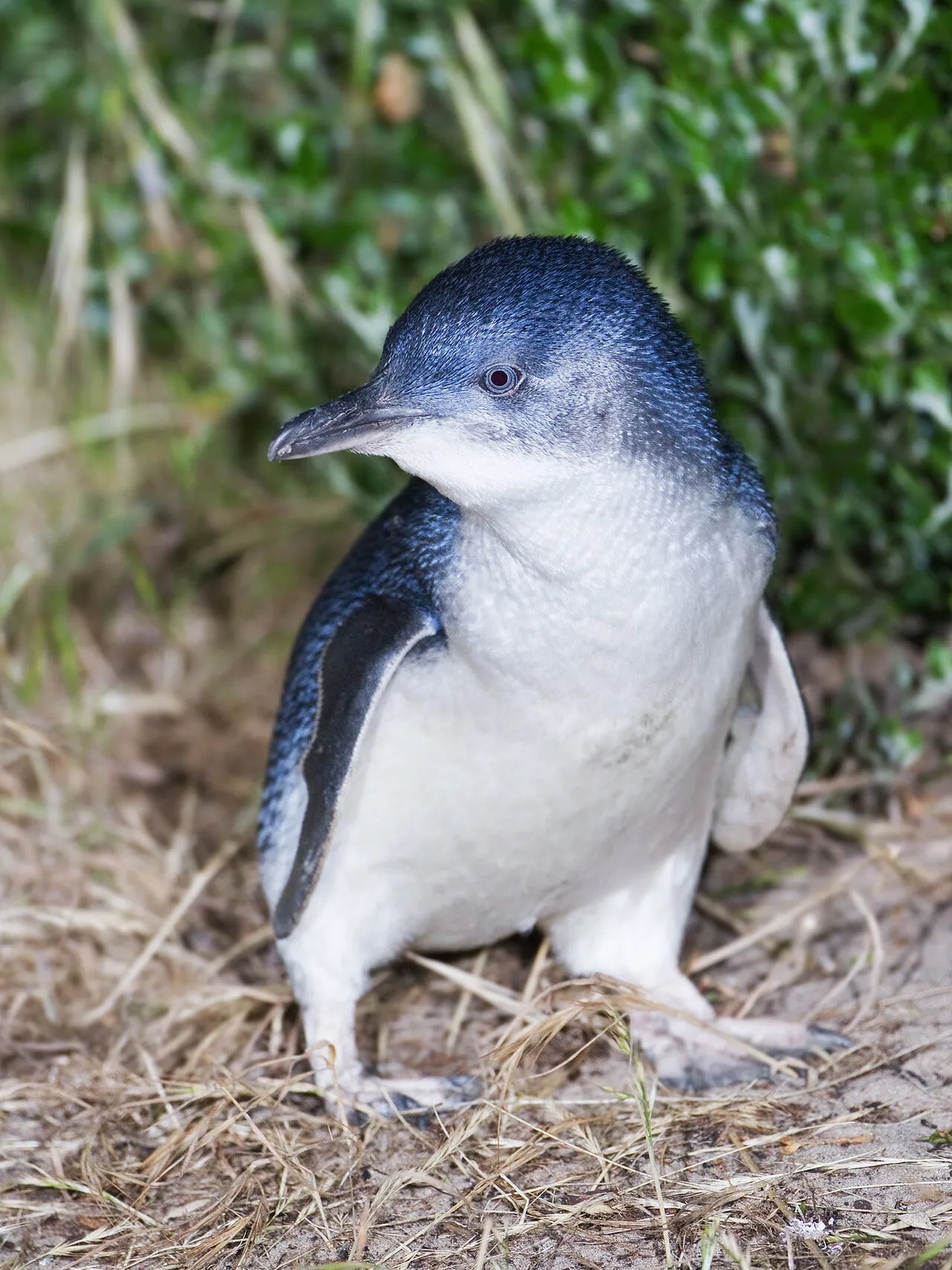
Little Penguin
Scientific name Eudyptula minor
Page last checked: 2026/11/01
The smallest of all penguins. On the coasts of southern Australia and New Zealand it comes ashore after dark and raises its chicks in burrows and similar places.
Key facts
- Length
25–40 cm
- Weight
1 kg
- Population
469,760 mature individuals (2016 survey)
- Range
It lives only in Australia and New Zealand. In Australia it is found on the southern coasts and Tasmania, and in New Zealand on the coasts of the North Island, the South Island, Stewart Island and the Chatham Islands, and on nearby islands. It stays in inshore waters during the breeding season and ranges farther offshore outside it.
In Australia it lives along the coast from Carnac Island in Western Australia to Broughton Island in New South Wales, although some stretches of the southern coast have no colonies. The largest colony is on Phillip Island in Victoria, home to about 40,000 birds, and there is also a colony on Penguin Island in Western Australia. Large colonies in New Zealand include Motunau Island, Pohatu Bay on Banks Peninsula, and Oamaru. One source says it is absent from Fiordland and South Westland, while another lists Fiordland among its main breeding areas.
Created with Grok
Features
The smallest of all penguins, with a blue back and a white belly. It is the only penguin that is active on land at night, coming ashore in groups after dusk and going to sea before dawn. It is also the only penguin that can lay two or more clutches in one breeding season. It sometimes nests under seaside houses and sheds, raising its chicks right next to people.
How to identify
- Belly: White
- Back: Blue to dark indigo
Created with Grok
- It is the smallest of all penguins, weighing about 1 kg.
- The back is blue to dark indigo and the belly is white; it is the only penguin with blue and white plumage.
- Newly fledged juveniles of the Fiordland penguin and similar species also have a dark blue back, but they are more than 1.5 times its size and have at least a trace of yellow in front of or above the eye.
- Birds on Banks Peninsula and in North Canterbury have a paler back and broader white edges at the front and rear of the flippers.
Chicks and juveniles
- Chick
Until about 1.5–2.5 months old
- Down: Dark gray, replaced by chocolate brown
Created with Grok
A newly hatched chick is covered in dark gray down, which is soon replaced by chocolate-brown down.
- Juvenile
From about 1.5–2.5 months old
- Back: Brighter blue than an adult
Created with Grok
A newly fledged juvenile has a brighter blue back than an adult and is considerably smaller.
Life
It feeds mainly on small schooling fish, and also eats squid, crustaceans such as krill, and jellyfish, but its diet varies widely between colonies and years. Most dives are no deeper than 30 m (given as 20–30 m, or 10–30 m on average), and the deepest recorded dive is 72 m. During the breeding season it feeds near the colony, within 20 km, or within 50 km for most birds on Phillip Island. Once a year it stays ashore for about 2 weeks (about 17 days according to one source) to molt, and because it cannot swim during that time it goes without food.
Breeding
The timing of breeding differs by region; in New Zealand eggs are laid from July to mid-November, and on Phillip Island the breeding season runs from August to February. Nests are made near the sea in burrows the birds dig themselves, in rock crevices and caves, and also under buildings and in nest boxes. It usually lays two white eggs, and both parents take turns incubating them for about 35–37 days. For a while after hatching, chicks are guarded by one parent (given as about 2 weeks, or 18–38 days); after that both parents go to sea and bring back food, and chicks fledge at about 7–9 weeks.
Other penguins
- King Penguin
- Emperor Penguin
- Adelie Penguin
- Chinstrap Penguin
- Gentoo Penguin
- Little Penguin
- African Penguin
- Magellanic Penguin
- Humboldt Penguin
- Galapagos Penguin
- Yellow-eyed Penguin
- Macaroni Penguin
- Royal Penguin
- Erect-crested Penguin
- Fiordland Penguin
- Snares Penguin
- Northern Rockhopper Penguin
- Western Rockhopper Penguin
- Eastern Rockhopper Penguin
Sources
- AviList v2026 (The Global Avian Checklist) (AviList Core Team, checked 2026/11/01)
Used for: Range and breeding sites - Little Penguin Eudyptula minor (Species factsheet) (BirdLife International, checked 2026/10/26)
Used for: Length, Range and breeding sites, Population, Features, Life, Breeding
Values from this source: Absent from Fiordland and South Westland / Dives to 20–30 m / 469,760 breeding adults, a figure first given in the 2016 assessment by compiling counts from many colonies - Little penguin | Kororā (New Zealand Birds Online, checked 2026/10/25)
Used for: Length, Weight, Range and breeding sites, How to identify, Chicks and juveniles, Features, Life, Breeding
Values from this source: Lists Fiordland among the main breeding areas / Feeds within 20 km during the breeding season / Chicks are guarded by one parent for 18–38 days / Chicks fledge at 7–8 weeks - Little penguin/kororā (Department of Conservation (New Zealand), checked 2026/10/09)
Used for: Length, Weight, Features, Life - Little penguins (Nature Note) (Phillip Island Nature Parks, checked 2026/10/09)
Used for: Weight, Range and breeding sites, How to identify, Features, Life, Breeding
Values from this source: Dives to 10–30 m on average / Most birds on Phillip Island feed within 50 km during the breeding season / Stays ashore for about 17 days to molt / Chicks are guarded by one parent for about 2 weeks - Research (Phillip Island Nature Parks, checked 2026/10/09)
Used for: Range and breeding sites, Life - Little Penguin (Birds in Backyards) (BirdLife Australia, checked 2026/10/09)
Used for: Length, Weight, How to identify, Chicks and juveniles, Breeding
Values from this source: Chicks are guarded by one parent for about 2 weeks - オーストラリアから輸送したフェアリーペンギンの有精卵がふ化。ヒナが順調に成育中!(葛西臨海水族園) (東京都 (2026-07-14), checked 2026/10/26)
Used for: Length, Weight, Breeding
Values from this source: Calls it フェアリーペンギン (fairy penguin) in Japanese, and lists ブルーペンギン, リトルペンギン, コビトペンギン and コガタペンギン among its other names - Checklist of the Birds of New Zealand (5th edition, Ornithological Society of New Zealand Occasional Publication No. 1) (Ornithological Society of New Zealand (2022), checked 2026/10/09)
Used for: Range and breeding sites - Penguin Island (Department of Biodiversity, Conservation and Attractions (Western Australia), checked 2026/10/09)
Used for: Range and breeding sites - Eudyptula minor (little penguin) (Animal Diversity Web (University of Michigan Museum of Zoology), checked 2026/10/25)
Used for: Chicks and juveniles
Values from this source: Chicks fledge at 50–65 days old