
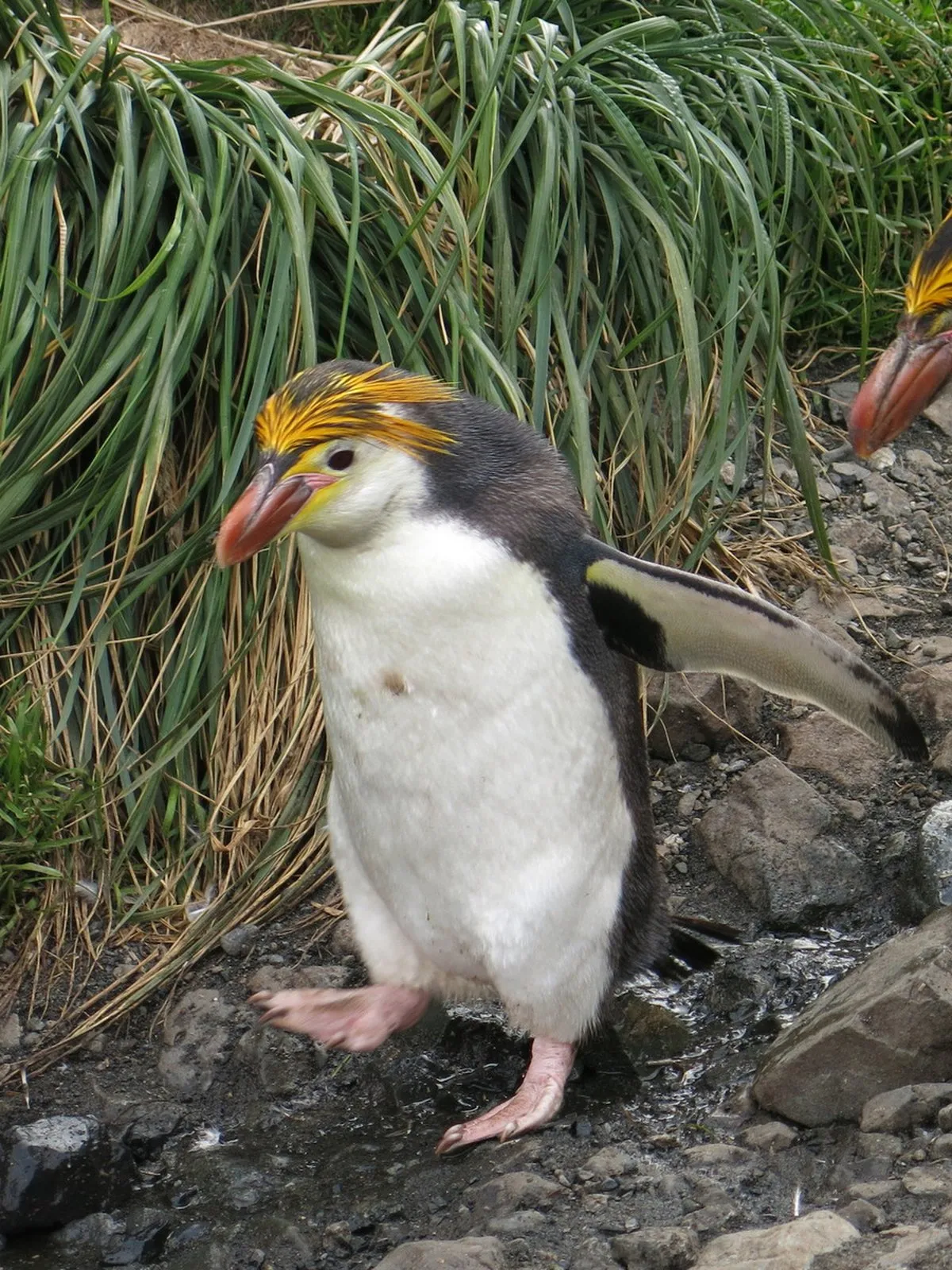
Royal Penguin
Scientific name Eudyptes schlegeli
Page last checked: 2026/11/01
A penguin with a white face and a yellow crest that joins across the forehead. It breeds only on Macquarie Island, an Australian territory, and the small islands right beside it.
Key facts
- Length
65–75 cm
- Weight
3–8 kg
- Population
750,037 pairs (2016 survey)
- Range
During the breeding season it travels to feed as far as the northern edge of the zone where the cold Antarctic waters meet the warmer waters to the north. It leaves the island after the molt, but where it goes in winter is unclear; it is said either to winter mainly in the seas near the breeding grounds, with juveniles ranging farther, or to travel long distances of up to 10,000 km after the molt. One source says its destination is still unknown, and another says it is unknown but thought to be the subantarctic waters near Macquarie Island. Stray birds have been recorded in Tasmania, New Zealand, South Georgia and elsewhere.
Its only breeding sites are Macquarie Island, an Australian territory in the subantarctic waters southeast of Australia, and the Bishop and Clerk Islets just to its south. Most birds breed on Macquarie Island, nesting in large colonies on bare, level sand or pebbly ground on slopes and hills from near the shore to 1.5–1.6 km inland.
Created with Grok
Features
A penguin that breeds only on Macquarie Island and the small islands right beside it, and the largest of the crested penguins. Its white face, large bill and yellow crest joined across the forehead are conspicuous. It lays two eggs, but the small first egg rarely produces a chick, and usually only the one chick from the larger second egg is raised. It forms very large colonies.
How to identify
- Crest: Yellow, joined across the forehead
- Bill: Large, with pink skin at the base
- Face and throat: White to pale gray
Created with Grok
- The face and throat are white to pale gray, which tells it from the macaroni penguin with its black face and throat, although a few birds have a dark gray or black face.
- The yellow crest joins across the forehead, as in the macaroni penguin; in the other crested penguins the crest is separate on each side.
- The bill is large, its color given as orange or as reddish brown, with pink skin visible at the base.
- It is slightly larger than the macaroni penguin.
- The chinstrap penguin also has a white face, but its bill is slender and black and it has no yellow feathers on the head.
Chicks and juveniles
- Chick
Until about 2–2.5 months old
- Head and back: Dark grayish brown
- Belly: White
Created with Grok
A newly hatched chick is covered in down that is brown on the head and back and white on the belly. The down later thickens, and the head and back turn dark grayish brown.
- Juvenile
From about 2–2.5 months old
- Crest: A few small yellow feathers on the forehead
- Bill: Small and slender, blackish brown
- Chin and throat: Gray
Created with Grok
A newly fledged juvenile is smaller than an adult, its crest is no more than a scattering of small yellow feathers on the forehead, and its chin and throat are gray. The bill is also smaller and more slender than an adult's and is blackish brown. The crest takes several years to grow fully.
Life
It feeds mainly on krill (small shrimp-like animals), and also eats small fish such as lanternfish, and squid; the proportions vary with the stage of breeding, between the east and west coasts of the island, and from year to year. It catches prey by pursuit diving and sometimes dives deeper than 100 m. During the breeding season it travels to feed in waters several hundred kilometers from Macquarie Island. After breeding it fattens up at sea, returns to the island to molt around February–April, and then leaves the island to spend the winter at sea.
Breeding
Males return to the colony first, from mid-September to early October, to reclaim the previous year's nest site; females arrive a little later, and in October–November two eggs of different sizes are laid in a hollow in pebbles or sand. Both parents take turns incubating, for a period given as about 30 days or about 35 days. After hatching, the male guards the chick for a while and the female brings food, for a period given as 3–4 weeks or 10–20 days; chicks then form groups with other chicks and both parents bring food. Fledging is given as around the end of January (about 65 days after hatching), or from the end of February.
Other penguins
- King Penguin
- Emperor Penguin
- Adelie Penguin
- Chinstrap Penguin
- Gentoo Penguin
- Little Penguin
- African Penguin
- Magellanic Penguin
- Humboldt Penguin
- Galapagos Penguin
- Yellow-eyed Penguin
- Macaroni Penguin
- Royal Penguin
- Erect-crested Penguin
- Fiordland Penguin
- Snares Penguin
- Northern Rockhopper Penguin
- Western Rockhopper Penguin
- Eastern Rockhopper Penguin
Sources
- AviList v2026 (The Global Avian Checklist) (AviList Core Team, checked 2026/11/01)
Used for: Range and breeding sites
Values from this source: Winters mainly in the seas near the breeding grounds, with juveniles ranging farther - Royal Penguin Eudyptes schlegeli (Species factsheet) (BirdLife International, checked 2026/10/26)
Used for: Range and breeding sites, Population, Features, Life - Royal penguin (New Zealand Birds Online, checked 2026/10/26)
Used for: Length, Weight, Range and breeding sites, How to identify, Chicks and juveniles, Features, Life, Breeding
Values from this source: Travels up to 10,000 km after the molt / The bill is orange / Eggs are incubated for about 35 days / Chicks fledge around the end of January (about 65 days after hatching) - Royal penguin (Australian Antarctic Division (Australian Antarctic Program), checked 2026/10/26)
Used for: Weight, Range and breeding sites, How to identify, Chicks and juveniles, Features, Life, Breeding
Values from this source: Its winter destination is still unknown / Eggs are incubated for about 30 days / The male guards the chick for 3–4 weeks / Chicks fledge from the end of February - Royal Penguin Eudyptes schlegeli (Marchant & Higgins (eds.), Handbook of Australian, New Zealand and Antarctic Birds, Vol. 1, excerpt) (Oxford University Press (1990), checked 2026/10/26)
Used for: Length, Weight, Range and breeding sites, How to identify, Chicks and juveniles, Features, Life, Breeding
Values from this source: Its winter destination is thought to be the subantarctic waters near Macquarie Island / The bill is reddish brown / Eggs are incubated for about 35 days / The male guards the chick for 10–20 days / Chicks fledge around the end of January (about 65 days after hatching) - Population status of the endemic royal penguin (Eudyptes schlegeli) at Macquarie Island (Salton et al., Polar Biology 42: 771–781) (Springer (2019), checked 2026/10/09)
Used for: Population
Values from this source: About 750,000 breeding pairs in 2016 (669,538–830,154), using a different method from the 1984–85 survey - Eudyptes schlegeli (royal penguin) (Kirsty de Wit) (Animal Diversity Web (University of Michigan Museum of Zoology, 2017), checked 2026/10/25)
Used for: Length, Chicks and juveniles, Features, Life, Breeding
Values from this source: Chicks fledge at about 65 days old