
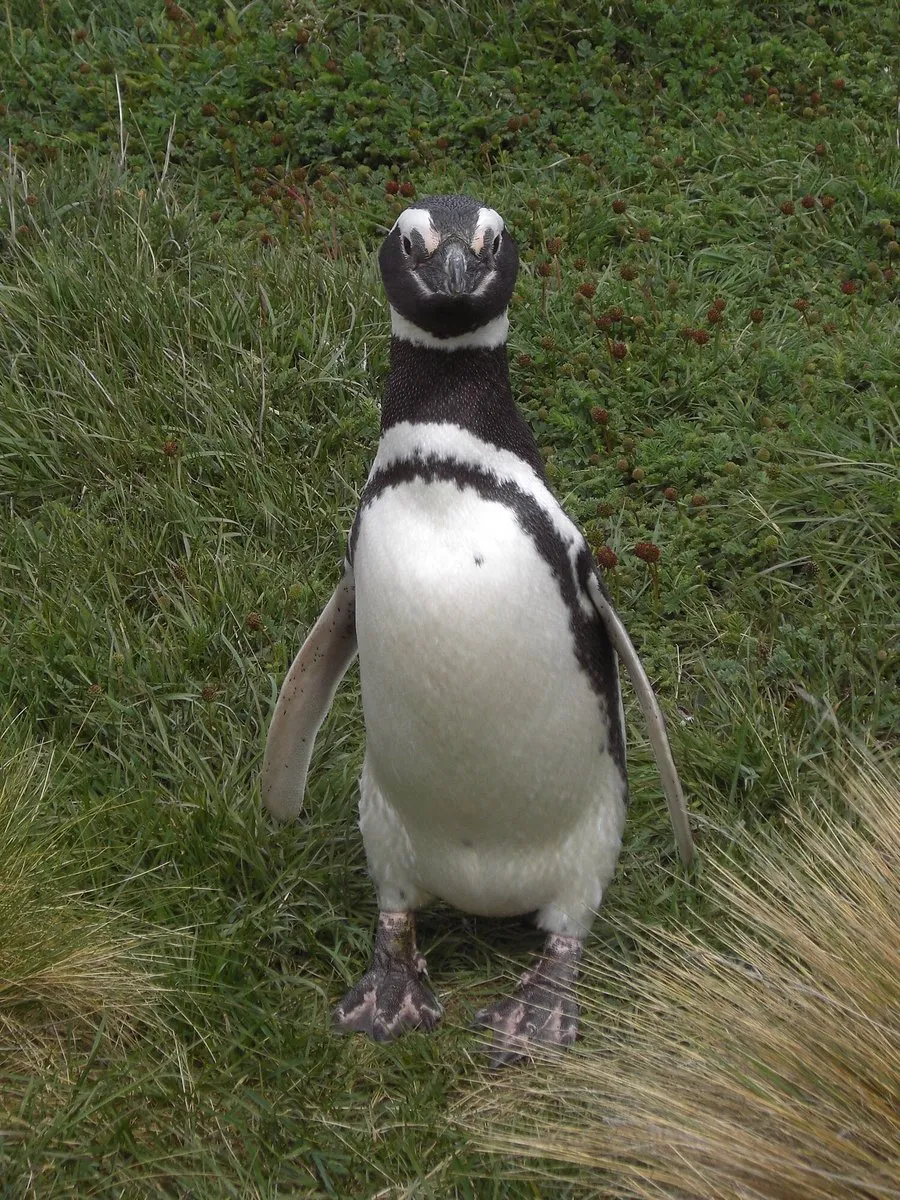
Magellanic Penguin
Scientific name Spheniscus magellanicus
Page last checked: 2026/11/01
A penguin that nests in burrows dug in the ground or under bushes on the coasts of southern South America and the Falkland Islands, recognized by the two black bands across its throat and breast.
Key facts
- Length
61–72 cm
- Weight
2.5–7.5 kg
- Population
1,350,000 pairs (2020 survey)
- Range
After the breeding season it lives at sea, and many birds on the Atlantic side move north in winter as far as northern Argentina, Uruguay and southern Brazil. Birds on the Pacific side do not travel as far. Stray birds have been found as far north as El Salvador and as far south as the Antarctic Peninsula, and also in Australia and New Zealand.
It breeds on the Atlantic and Pacific coasts of South America, with colonies in Argentina, Chile and the Falkland Islands. Its breeding range is given as central Chile and central Argentina south to Cape Horn and the Falkland Islands. Northern Patagonia in Argentina (Chubut and Río Negro provinces) is the center of the known population. Nests are made in scrub and grassland in Argentina, in tall tussock grass in the Falkland Islands, and in temperate forest in Chile.
Created with Grok
Features
A penguin that breeds on the temperate coasts of southern South America, recognized by the two black bands across its throat and breast. Because of its loud, donkey-like call it is known in the Falkland Islands as the "jackass" (a male donkey). At its colonies it nests in burrows dug in the ground or under bushes, raising its chicks in large, dense groups.
How to identify
- Around the eye: Bare pink skin
- White band: From above the eye around the head to the neck
- Throat and breast: Two black bands
Created with Grok
- A white band runs from above the eye around the side of the head and joins at the neck, and there are two black bands, one below the throat and one across the breast.
- It resembles the Humboldt penguin, but the black band on the neck is thicker, the white eyebrow-like band is broader, and the area of pink skin at the base of the bill is smaller.
- There is bare pink skin around the eye.
Chicks and juveniles
- Chick
- Down: Gray
Created with Grok
Chicks are covered in gray down.
- Juvenile
- Cheeks: White to dark gray
- Breast bands: Less distinct than in adults
Created with Grok
In juveniles the black breast bands are less distinct than in adults, and the cheeks range from white to dark gray.
Life
It feeds mainly on small fish and squid, and anchovies and young hake (a fish related to cod) are also important prey. It usually dives to a few tens of meters and sometimes to nearly 100 m. Even while raising chicks it may travel to waters several hundred kilometers from the colony to feed. After the breeding season it moves to northern waters for the winter.
Breeding
Birds arrive at the colony in early September and lay two eggs in a burrow dug in the ground or a nest under a bush. Laying is given as mid-October to mid-November in the Falkland Islands, or as late October. Both parents take turns incubating the eggs for 40–42 days, and chicks fledge from January to early March, or in February in the Falkland Islands. Parents do not care for fledged chicks and stay ashore to molt.
Other penguins
- King Penguin
- Emperor Penguin
- Adelie Penguin
- Chinstrap Penguin
- Gentoo Penguin
- Little Penguin
- African Penguin
- Magellanic Penguin
- Humboldt Penguin
- Galapagos Penguin
- Yellow-eyed Penguin
- Macaroni Penguin
- Royal Penguin
- Erect-crested Penguin
- Fiordland Penguin
- Snares Penguin
- Northern Rockhopper Penguin
- Western Rockhopper Penguin
- Eastern Rockhopper Penguin
Sources
- AviList v2026 (The Global Avian Checklist) (AviList Core Team, checked 2026/11/01)
Used for: Range and breeding sites
Values from this source: The breeding range is central Chile and central Argentina south to Cape Horn and the Falkland Islands - Magellanic Penguin Spheniscus magellanicus (Species factsheet) (BirdLife International, checked 2026/10/26)
Used for: Range and breeding sites, Population, Life
Values from this source: Northern Patagonia in Argentina (Chubut and Río Negro provinces) is the center of the known population / 1.1–1.6 million breeding pairs (2.2–3.2 million mature individuals) / An estimate from the 2020 assessment, combining surveys from each site - Magellanic (Falklands Conservation, checked 2026/10/09)
Used for: Length, Weight, Range and breeding sites, How to identify, Features, Life, Breeding
Values from this source: Eggs are laid from mid-October to mid-November in the Falkland Islands / Chicks fledge in February in the Falkland Islands - Magellanic Penguin (SeaWorld Parks & Entertainment, checked 2026/10/09)
Used for: Length, Features, Life, Breeding - Spheniscus magellanicus (Magellanic penguin) (Animal Diversity Web (University of Michigan Museum of Zoology), checked 2026/10/09)
Used for: Weight, Range and breeding sites, How to identify, Chicks and juveniles, Features, Breeding
Values from this source: Eggs are laid in late October / Chicks fledge from January to early March - Magellanic Penguin (World Land Trust, checked 2026/10/09)
Used for: Chicks and juveniles, Life - Magellanic Penguin (Spheniscus magellanicus), version 1.1 (Martínez et al., Birds of the World) (Cornell Lab of Ornithology (2024), checked 2026/10/09)
Used for: How to identify - A second Magellanic Penguin in New Zealand (J. T. Darby, Notornis 38: 36) (Ornithological Society of New Zealand (1991), checked 2026/10/09)
Used for: Range and breeding sites, Chicks and juveniles