
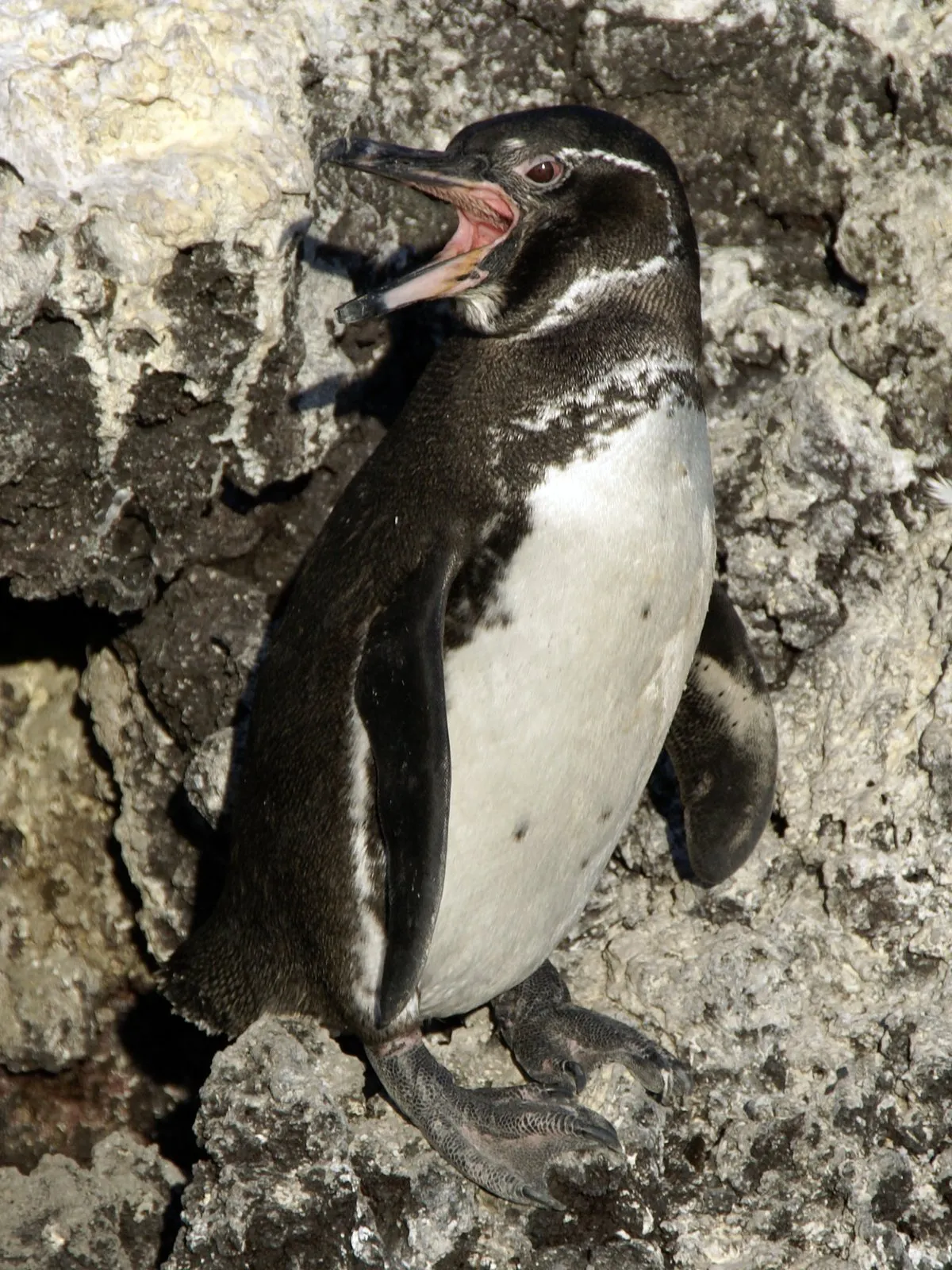
Galapagos Penguin
Scientific name Spheniscus mendiculus
Page last checked: 2026/11/01
The northernmost of all penguins. It lives only in the Galápagos Islands near the equator, nesting in crevices in the lava along the coast.
Key facts
- Length
49–55 cm
- Weight
1.7–2.6 kg
- Population
3,250 individuals (2009 survey)
- Range
It is endemic to the Galápagos Islands of Ecuador and lives in the waters around the islands all year round. Breeding birds feed in the sea along the shore near their nests, while non-breeding birds and juveniles move away from the groups. Stray birds have also been recorded as far as Panama.
It breeds mainly on the coasts of Isabela and Fernandina, in the west of the archipelago, and almost all birds are on these two islands. It also breeds on Floreana, Santiago and nearby islets, and Bartolomé is another breeding site. Nests are made in lava caves and crevices just above sea level.
Created with Grok
Features
The northernmost of all penguins; all of its breeding sites are in the tropics, and the one at the northern tip of Isabela is in the Northern Hemisphere. It is the second-smallest penguin after the little penguin, with an average length given as 49 cm or 53 cm. It can live in the tropics because cold, nutrient-rich water wells up around the western islands and attracts the fish it eats. It is closely related to the African, Humboldt and Magellanic penguins, but because the Galápagos Islands have no soft soil to dig in, it nests in lava caves and crevices.
How to identify
- White line on the head: Thin line from behind the eye around the chin, meeting at the throat
- Breast bands: Two black bands; the lower runs along the flanks to the legs
Created with Grok
- The head is black, with a thin white line that runs from behind the eye, around the black area by the ear and the chin, and meets at the throat.
- There are two black bands on the breast, and the lower one continues along the flanks to the top of the legs.
- It is smaller than the similar Magellanic penguin, and the white line on its head is the thinnest among the banded penguins.
Chicks and juveniles
- Chick
Until about 1.5–2.5 months old
- Body: Dark brown
Created with Grok
Chicks are dark brown.
Life
It feeds mainly on small schooling fish such as anchovies, sardines and mullet. It feeds in relatively shallow water close to shore. It often hunts in groups and catches its prey by approaching from below. It lives in the Galápagos Islands all year round, and where it lives is closely tied to the cold, nutrient-rich waters of the west.
Breeding
It has no fixed breeding season and breeds all year round, timed to periods when cold water wells up and food becomes plentiful. Pairs often stay together for life and lay their eggs in a nest in a lava cave or crevice; the clutch is given as one or two eggs, or two. Both parents take turns incubating, for a period given as 35–40 days or 38–42 days. Chicks fledge at about 8–9 weeks, and if food is available the parents may go on feeding them after they fledge.
Other penguins
- King Penguin
- Emperor Penguin
- Adelie Penguin
- Chinstrap Penguin
- Gentoo Penguin
- Little Penguin
- African Penguin
- Magellanic Penguin
- Humboldt Penguin
- Galapagos Penguin
- Yellow-eyed Penguin
- Macaroni Penguin
- Royal Penguin
- Erect-crested Penguin
- Fiordland Penguin
- Snares Penguin
- Northern Rockhopper Penguin
- Western Rockhopper Penguin
- Eastern Rockhopper Penguin
Sources
- AviList v2026 (The Global Avian Checklist) (AviList Core Team, checked 2026/11/01)
Used for: Range and breeding sites - Galapagos Penguin Spheniscus mendiculus (Species factsheet) (BirdLife International, checked 2026/10/26)
Used for: Range and breeding sites, Population, Features, Life, Breeding
Values from this source: 1,800–4,700 individuals in 2009 - Spheniscus mendiculus, Galapagos penguin (SeaLifeBase, checked 2026/10/09)
Used for: Length, Weight - Spheniscus mendiculus (Galapagos penguin) (Joshua Wahlstrom) (Animal Diversity Web (University of Michigan Museum of Zoology), checked 2026/10/25)
Used for: Length, Weight, Range and breeding sites, How to identify, Chicks and juveniles, Features, Life, Breeding
Values from this source: Average length is 53 cm / Lays two eggs / Eggs are incubated for 38–42 days / Chicks fledge at about 60 days old - Galapagos penguin (Galapagos Conservation Trust, checked 2026/10/25)
Used for: Length, Weight, Range and breeding sites, Chicks and juveniles, Features, Life, Breeding
Values from this source: Average length is 49 cm / Lays one or two eggs / Eggs are incubated for 35–40 days / Chicks fledge at 8–9 weeks old - Galápagos Penguin (SeaWorld Parks & Entertainment, checked 2026/10/09)
Used for: Length, Weight, Breeding
Values from this source: Eggs are incubated for 38–42 days - 日本で飼育されたガラパゴスペンギン(福田道雄, 我孫子市鳥の博物館調査研究報告 24(1)) (我孫子市鳥の博物館 (2018), checked 2026/10/09)
Used for: Features