
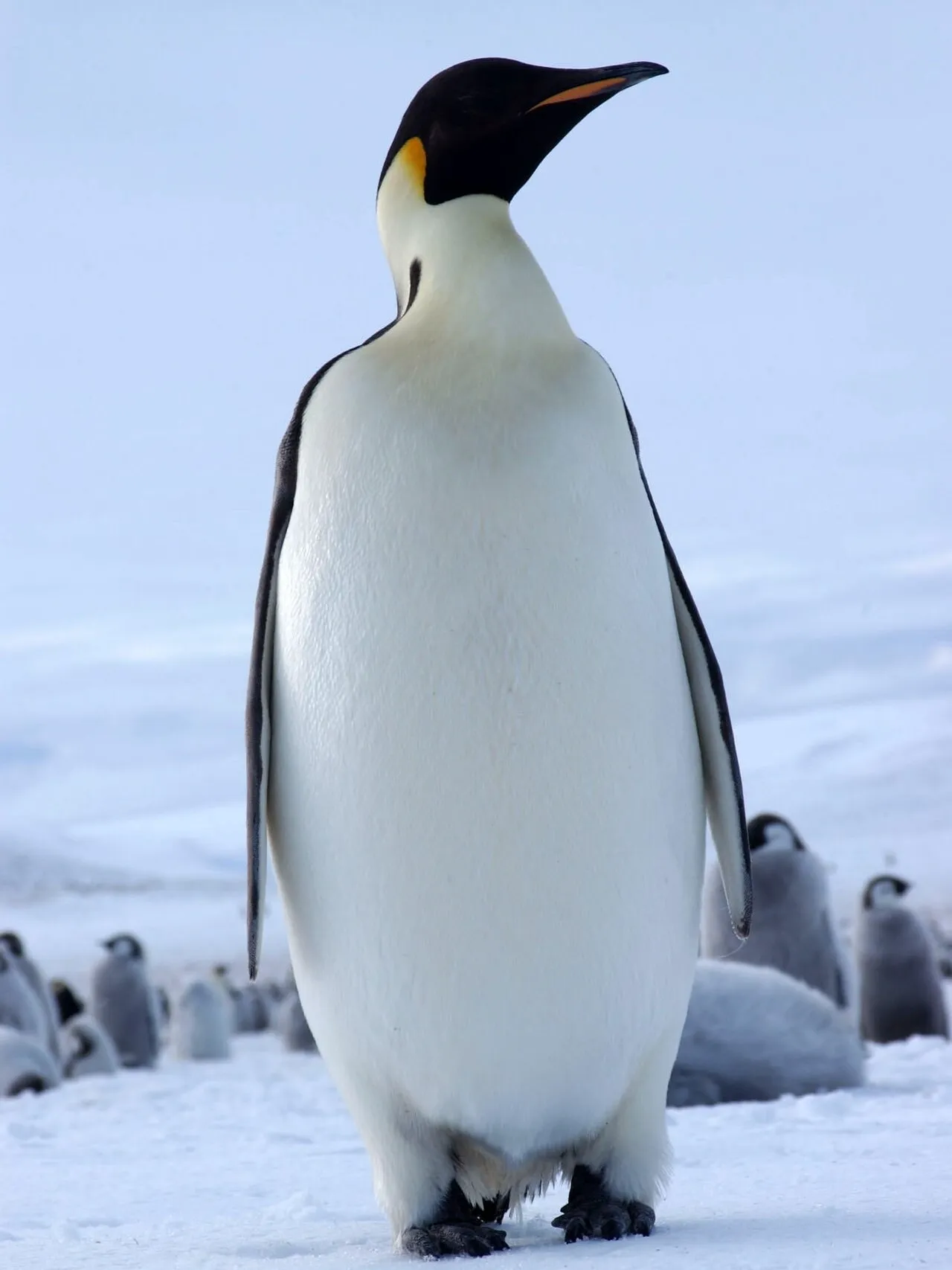
Emperor Penguin
Scientific name Aptenodytes forsteri
Page last checked: 2026/11/01
The largest of all penguins. It breeds on the sea ice along the coast of Antarctica during the Antarctic winter.
Key facts
- Length
100–130 cm
- Weight
20–45 kg
- Population
228,000 mature individuals (2018 survey)
- Range
It spends its whole life in Antarctic waters, usually ranging to the edge of the pack ice and the sea beyond it. Juveniles disperse especially widely, and stray birds have been recorded as far as the waters off New Zealand and Argentina.
Colonies are scattered around almost the entire coast of Antarctica. The number of known colonies differs between sources, given as 46 in a 2009 satellite survey, about 54, or 66 recorded colonies. Most are on fast ice (sea ice that stays fixed to the coast or to grounded icebergs), and the large colonies are concentrated in the Ross Sea and the Weddell Sea.
Created with Grok
Features
The largest of all penguins; some adults reach 40 kg at the start of the breeding season. It is the only animal that breeds during the Antarctic winter, and it forms its colonies on sea ice. Scale-like feathers overlapping in many layers and a thick layer of fat protect it from the cold.
How to identify
- Bill: Shorter than the king's
- Neck patch: Broad and yellow
- Upper breast: No orange area
- Flippers: Smaller for its body size than the king's
Created with Grok
- It is larger and heavier than the king penguin.
- The pale patch on each side of the neck is broad and yellow, not the narrow orange spoon shape of the king penguin.
- The bill is shorter than the king penguin's.
- It has no orange area on the upper breast like the king penguin's.
- For its body size, its flippers are smaller than those of the king penguin.
Chicks and juveniles
- Chick
Until about 4.5–5 months old
- Down: Silvery gray
Created with Grok
The chick's body is covered in silvery-gray down.
- Juvenile
From about 4.5–5 months old
- Neck patch: Whitish, not yellow
- Chin: White to dark gray, varies by individual
Created with Grok
A newly fledged juvenile is about half the size of an adult, and the patches on the sides of its neck are whitish rather than yellow. The color of the chin varies between individuals, from white to dark gray.
Life
It feeds mainly on small Antarctic fish, and also eats Antarctic krill (small shrimp-like animals that live in swarms in the Southern Ocean) and squid. It is an excellent diver, with recorded dives deeper than 500 m. During the summer molt it travels long distances in search of pack ice where it can stay out of the water for weeks. In the winter colonies, birds huddle together to keep from losing body heat.
Breeding
Birds gather at the colonies from late March to April and lay a single egg in May or June. Only the male incubates the egg, on his feet, for about two months; meanwhile the female goes to sea to feed, and the male endures a long fast. Once the chick hatches, both parents bring food, and older chicks form groups to protect themselves from the cold and from predators. Chicks fledge in December or January.
Other penguins
- King Penguin
- Emperor Penguin
- Adelie Penguin
- Chinstrap Penguin
- Gentoo Penguin
- Little Penguin
- African Penguin
- Magellanic Penguin
- Humboldt Penguin
- Galapagos Penguin
- Yellow-eyed Penguin
- Macaroni Penguin
- Royal Penguin
- Erect-crested Penguin
- Fiordland Penguin
- Snares Penguin
- Northern Rockhopper Penguin
- Western Rockhopper Penguin
- Eastern Rockhopper Penguin
Sources
- AviList v2026 (The Global Avian Checklist) (AviList Core Team, checked 2026/11/01)
Used for: Range and breeding sites - 世界のペンギン コウテイペンギン(夏の企画展示 2019「のぞいてみよう!ペンギンワールド」) (国立極地研究所 南極・北極科学館, checked 2026/10/08)
Used for: Length, Weight, Features, Life - Emperor penguin (New Zealand Birds Online, checked 2026/10/25)
Used for: Length, Weight, Range and breeding sites, How to identify, Chicks and juveniles, Features, Life, Breeding
Values from this source: Chicks fledge at 141 days on average - King penguin (New Zealand Birds Online, checked 2026/10/08)
Used for: How to identify - Emperor penguin (Australian Antarctic Division (Australian Antarctic Program), checked 2026/10/08)
Used for: Features, Life, Breeding - King penguin (Australian Antarctic Division (Australian Antarctic Program), checked 2026/10/08)
Used for: How to identify - Emperor penguin (John P. Rafferty) (Encyclopaedia Britannica, checked 2026/10/08)
Used for: Length, Weight, Range and breeding sites, Chicks and juveniles, Life, Breeding - Emperor Penguin Aptenodytes forsteri (Species factsheet) (BirdLife International, checked 2026/10/26)
Used for: Range and breeding sites, Life, Breeding
Values from this source: About 54 colonies - An Emperor Penguin Population Estimate: The First Global, Synoptic Survey of a Species from Space (Fretwell et al., PLoS ONE 7(4): e33751) (PLOS (2012), checked 2026/10/08)
Used for: Range and breeding sites
Values from this source: 46 colonies in a 2009 satellite survey - Advances in remote sensing of emperor penguins: first multi-year time series documenting trends in the global population (LaRue et al., Proceedings of the Royal Society B 291: 20232067) (The Royal Society (2024), checked 2026/10/08)
Used for: Range and breeding sites, Population
Values from this source: 66 recorded colonies - Aptenodytes forsteri (emperor penguin) (Animal Diversity Web (University of Michigan Museum of Zoology), checked 2026/10/25)
Used for: Chicks and juveniles
Values from this source: Chicks fledge and leave their parents at 5 months