
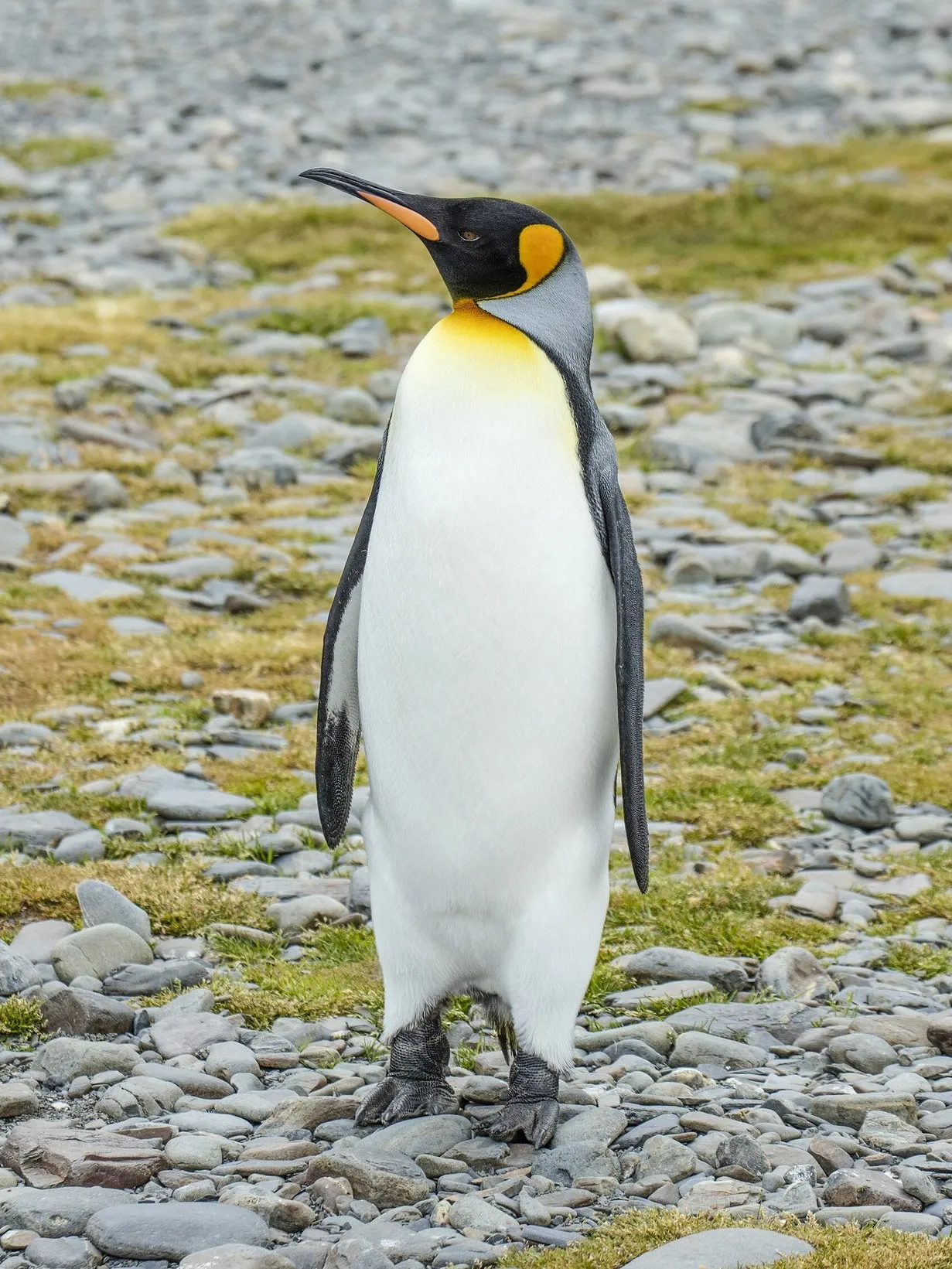
King Penguin
Scientific name Aptenodytes patagonicus
Page last checked: 2026/11/01
The second-largest penguin after the emperor penguin. It breeds on the beaches of subantarctic islands and takes more than a year to raise a chick.
Key facts
- Length
85–95 cm
- Weight
8–15 kg
- Population
1,100,000 pairs (2020 survey)
- Range
Outside the breeding season it lives mainly in the open ocean. Juveniles and non-breeding birds travel far from the breeding islands and disperse widely.
It breeds on flat, ice-free beaches of subantarctic islands. The main breeding sites are South Georgia, the Crozet Islands, the Kerguelen Islands, the Prince Edward Islands, Heard Island and Macquarie Island, and South Georgia is now the largest. There are also small colonies in the Falkland Islands and on Tierra del Fuego in southern Chile.
Created with Grok
Features
The second-largest penguin after the emperor penguin, and its closest relative. It builds no nest and incubates its egg on top of its feet. Because raising one chick takes more than a year, there are chicks in the colony all year round. Pairs are said to breed successfully once every two years, or twice every three years.
How to identify
- Bill: Long, with an orange stripe on the lower side
- Neck patch: Narrow spoon shape, golden orange
- Flippers: Larger for its body size than the emperor's
Created with Grok
- The patch on each side of the neck is a narrow spoon shape in bright golden orange. Pale orange continues down to the upper breast.
- It is smaller and slimmer than the emperor penguin, with a long bill that has an orange stripe on the lower mandible.
- For its body size, its flippers are larger than those of the emperor penguin.
Chicks and juveniles
- Chick
Until about 10–13.5 months old
- Down: Brown
Created with Grok
A newly hatched chick is blackish and almost naked, and is later covered in brown down. Adult-colored feathers begin to show as the brown down is shed.
- Juvenile
From about 10–13.5 months old
- Crown: Black feathers with gray tips
Created with Grok
Juveniles look like adults, but the feathers on the crown are black with gray tips.
Life
It feeds mainly on lanternfish, and takes more squid in winter. It catches prey by pursuit diving; the deepest recorded dive is 343 m, and dives are also said to exceed 360 m. Outside the breeding season it travels far from the colony in search of food.
Breeding
Birds arrive at the colony from September to November and lay a single egg between November and April. Both parents take turns incubating the egg on their feet for about 54 days, with the male taking the first shift. Chicks eventually gather in groups, and because their parents bring food only occasionally during winter, they may wait for months without eating. One breeding cycle lasts more than a year, given as 14–15 months, or 13–16 months including the period before the molt.
Other penguins
- King Penguin
- Emperor Penguin
- Adelie Penguin
- Chinstrap Penguin
- Gentoo Penguin
- Little Penguin
- African Penguin
- Magellanic Penguin
- Humboldt Penguin
- Galapagos Penguin
- Yellow-eyed Penguin
- Macaroni Penguin
- Royal Penguin
- Erect-crested Penguin
- Fiordland Penguin
- Snares Penguin
- Northern Rockhopper Penguin
- Western Rockhopper Penguin
- Eastern Rockhopper Penguin
Sources
- AviList v2026 (The Global Avian Checklist) (AviList Core Team, checked 2026/11/01)
Used for: Range and breeding sites - King penguin (New Zealand Birds Online, checked 2026/10/25)
Used for: Length, Weight, Range and breeding sites, How to identify, Chicks and juveniles, Features, Life, Breeding
Values from this source: Pairs breed successfully twice every three years / The deepest recorded dive is 343 m / Chicks fledge at 305–396 days (11 months on average) / About 2.23 million breeding pairs - Emperor penguin (New Zealand Birds Online, checked 2026/10/08)
Used for: How to identify - King penguin (Australian Antarctic Division (Australian Antarctic Program), checked 2026/10/08)
Used for: Length, Weight, Range and breeding sites, How to identify, Chicks and juveniles, Features, Life, Breeding
Values from this source: Pairs breed successfully once every two years at best / One breeding cycle lasts 13–16 months including the period before the molt / About 1.6 million breeding pairs - King Penguin Aptenodytes patagonicus (Species factsheet) (BirdLife International, checked 2026/10/26)
Used for: Range and breeding sites, Population, Features, Life, Breeding
Values from this source: Pairs breed successfully once every two years at best / The deepest dives exceed 360 m / One breeding cycle lasts 14–15 months / About 1.1 million breeding pairs (1,084,320–1,228,320) / An estimate from the 2020 assessment, combining surveys from each site - King Penguin (SeaWorld Parks & Entertainment, checked 2026/10/25)
Used for: Chicks and juveniles
Values from this source: Chicks depend on their parents for up to 13 months, until their waterproof feathers grow